The third quarter proved to be a somewhat quieter period than the tumultuous second quarter, as investors continued navigating an uncertain economic environment and the country turned attention toward the November midterm elections.
With control of Congress hanging in the balance, the coming months promise no shortage of political debate, economic speculation, and the usual election-year theatrics. While the headlines may have been somewhat less dramatic this quarter, several important developments beneath the surface deserve our attention, particularly the direction of interest rates and an increasingly divided stock market.
Interest Rates and the Frozen Housing Market
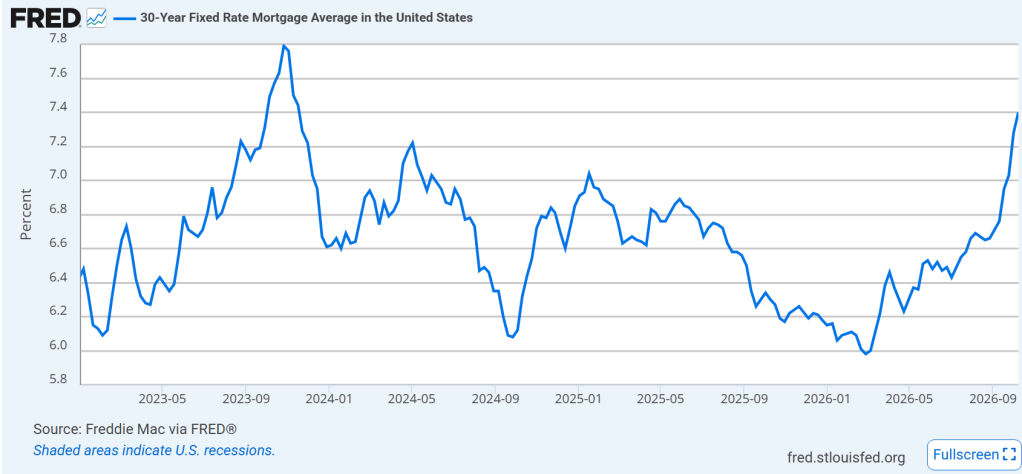
One of the more consequential developments of the third quarter was the renewed upward pressure on interest rates, complicating an already challenging environment for the American housing market.
After beginning the quarter with the average 30-year mortgage rate at 6.43%, rates climbed to 7.03% by late September, according to Freddie Mac’s historical mortgage rate data. Meanwhile, the Federal Reserve raised its benchmark interest rate by 25 basis points on September 16, its first increase in more than three years, due to concerns about persistent inflation.
For prospective homebuyers, this was hardly welcome news.
According to the National Association of Realtors’ August existing-home sales report, existing-home sales fell 2% in August to an annualized rate of just 3.98 million homes. Despite the slowdown in transactions, the median existing-home price actually increased 1.6% from the previous year, reaching $429,100.
This is a particularly frustrating combination. Homebuyers are facing both historically elevated prices and substantially higher financing costs, while many existing homeowners have little incentive to sell, given long term financing at low rates.
Spend any amount of time on social media, and you’ll inevitably come across young Americans expressing frustration about the cost of homeownership. Why could their parents afford a house on a single income, while two college-educated professionals today struggle to purchase their first home?
And frankly, that frustration is warranted. Things are unaffordable for young families.
The problem isn’t quite as simple as suggesting that previous generations had everything handed to them. Mortgage rates exceeded 15% in the early 1980s, and previous generations faced their own economic difficulties. But homes were generally much less expensive relative to household incomes, and the extraordinary increase in home prices over the past several years has made an already difficult situation considerably worse.
During the pandemic, mortgage rates fell below 3%, allowing millions of Americans to lock in extraordinarily cheap financing for the next thirty years. At the same time, limited housing supply, changing consumer preferences, and inexpensive credit helped fuel a remarkable increase in home prices.
When interest rates subsequently surged, those higher prices didn’t simply disappear.
But perhaps the more interesting consequence has been what economists call the mortgage lock-in effect. Millions of homeowners are sitting on mortgages below 4%, making the prospect of selling their homes and taking on substantially more expensive financing decidedly unattractive.
The result is a housing market caught in something of a stalemate. Existing homeowners are reluctant to sell, prospective buyers struggle with affordability, and transaction volumes remain depressed.
For investors, the implications extend far beyond residential real estate. Homebuilders, mortgage lenders, real estate brokerages, home improvement retailers, and countless other businesses depend on a healthy housing market. When fewer people move, fewer mortgages are originated, fewer commissions are earned, and fewer kitchens are renovated.
As an investor who has owned both homebuilder and home improvement stocks, I’ve watched these developments particularly closely. Until some combination of lower interest rates, increased housing supply, or higher household incomes restores affordability, I suspect these industries will continue facing considerable headwinds.
The Illusion of Market Highs
If you spent the third quarter watching the S&P 500, you might reasonably conclude that things were going well for American investors. The index continued reaching new all-time highs, and the seemingly unstoppable march of the stock market continued.
But for many individual investors, the experience was considerably less pleasant.
While the largest companies in America continued seeing their share prices climb, countless smaller businesses went in the opposite direction. Stocks with little exposure to artificial intelligence, particularly those sensitive to higher interest rates or a weakening consumer, found themselves increasingly out of favor.
During the third quarter, the S&P 500 gained approximately 2.8%, while the equally weighted S&P 500 declined 1.7%. The latter gives each constituent company the same weighting, rather than favoring the largest businesses.
In other words, the headline index was reaching new highs while many of the companies within that very same index were struggling.
The largest technology companies have become so enormous that their performance increasingly dictates the direction of the broader market. The ten largest companies now account for approximately 40% of the S&P 500, allowing their gains to more than offset weakness elsewhere.
Much of this success has been driven by the extraordinary enthusiasm surrounding artificial intelligence.
Microsoft, Alphabet, Amazon, and Meta are collectively investing hundreds of billions of dollars into data centers, semiconductor chips, and the infrastructure necessary to support AI. Those expenditures have created a remarkable boom for the businesses supplying the proverbial picks and shovels.
As a longtime investor in semiconductor equipment manufacturers, I’ve certainly benefited from this trend. But I wonder how long the broader market can remain so heavily dependent on a relatively small group of businesses.
Conversely, the neglect of smaller businesses may eventually create opportunities for investors willing to look elsewhere.
Looking ahead, I’ll be particularly interested in whether the market begins to broaden beyond its largest constituents, or whether the major indexes remain increasingly dependent on the fortunes of a handful of technology giants.
Q3 Performance
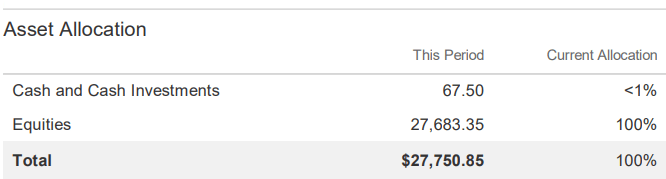
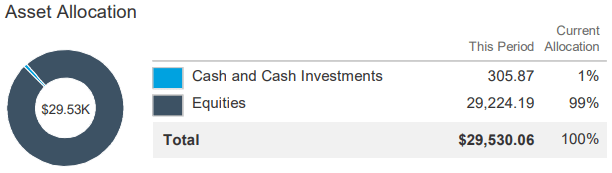
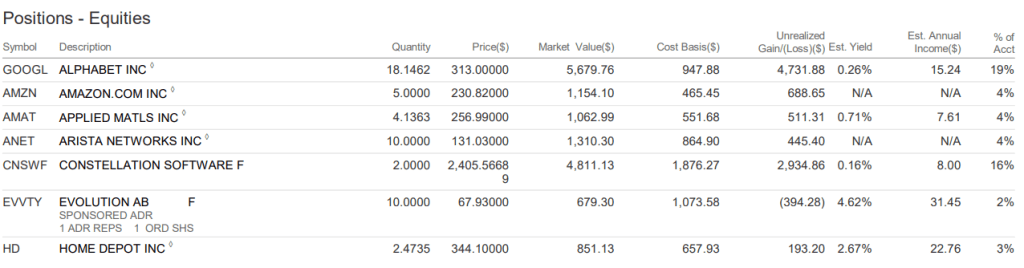
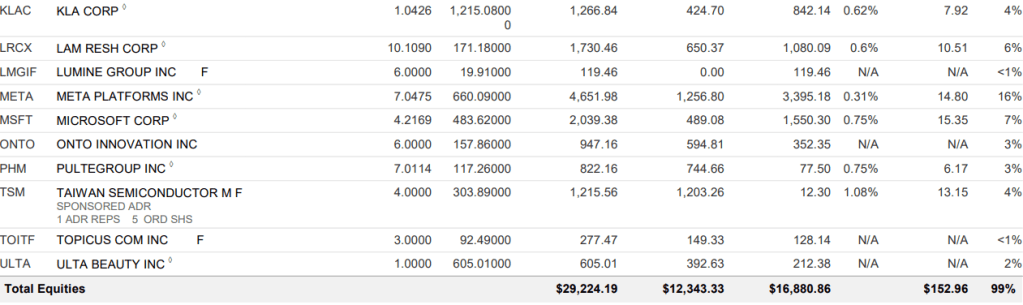
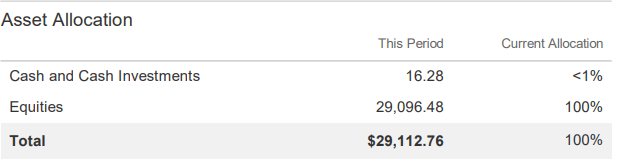
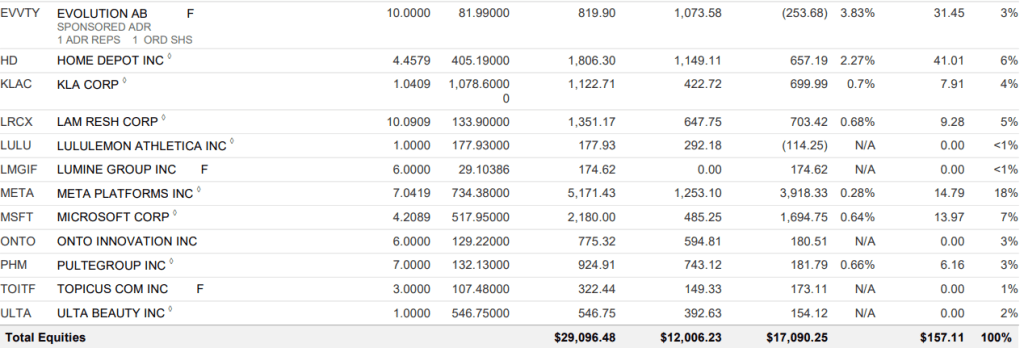
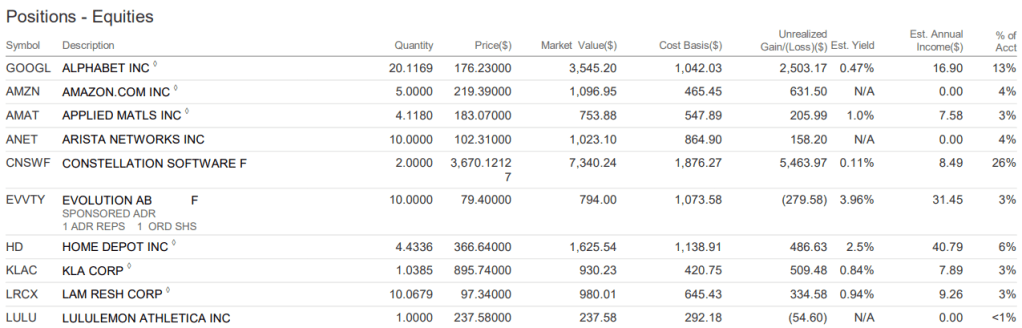
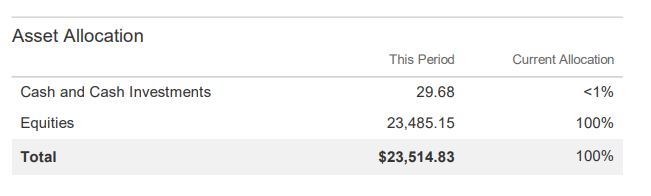
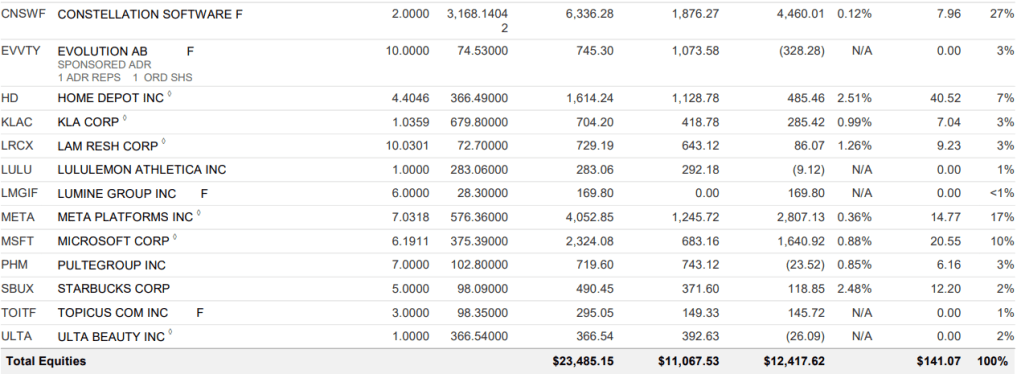
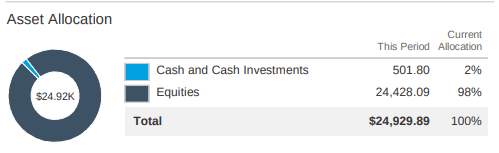
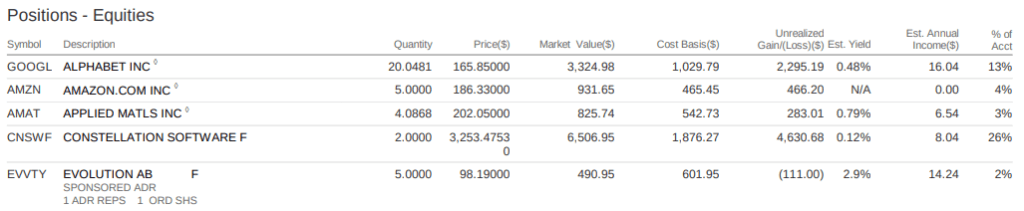
As of 10/1/2026, my 10K portfolio was worth $36,211.43. When I started on 8/19/2018, the SPY had a price of $285.06 and my account started with $10,000. As of 10/1/2026 the SPY had a price of $763.99. In reality, the SPY has done even better due to dividends given out, so I have accounted for dividend reinvestment in the return calculation.
| Year | 10K Portfolio | SPY | Outperformance |
|---|---|---|---|
| 2018 (8/19–12/31) | -13.95% | -13.71% | -0.24% |
| 2019 | 37.33% | 32.60% | 4.73% |
| 2020 | 21.22% | 17.59% | 3.63% |
| 2021 | 38.55% | 28.43% | 10.12% |
| 2022 | -27.25% | -18.65% | -8.60% |
| 2023 | 41.36% | 26.72% | 14.64% |
| 2024 | 21.39% | 25.59% | -4.20% |
| 2025 | 19.26% | 18.00% | 1.26% |
| 2026 (1/1–3/31) | -6.03% | -4.54% | -1.49% |
| 2026 (4/1–6/30) | 30.16% | 14.26% | 15.90% |
| 2026 (7/1–9/30) | 0.25% | 2.70% | -2.45% |
| Since Inception (8/19/18) | 262.11% | 203.02% | 59.09% |
| CAGR | 17.18% | 14.63% | 2.55% |
The third quarter saw very little change to my portfolio values, with my account going up a quarter of a percent. The SPY fared somewhat better, climbing 2.7%. Though this divergence is hardly noteworthy. Overall, my portfolio continues to compound well, and my CAGR remains over 2.5% above the SPY. If I could keep that up in perpetuity, I will be extremely happy.
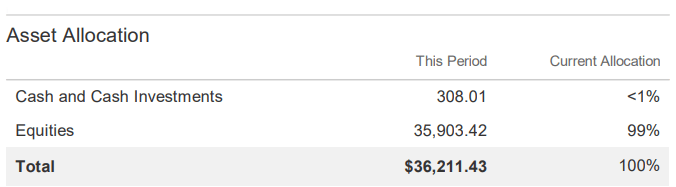

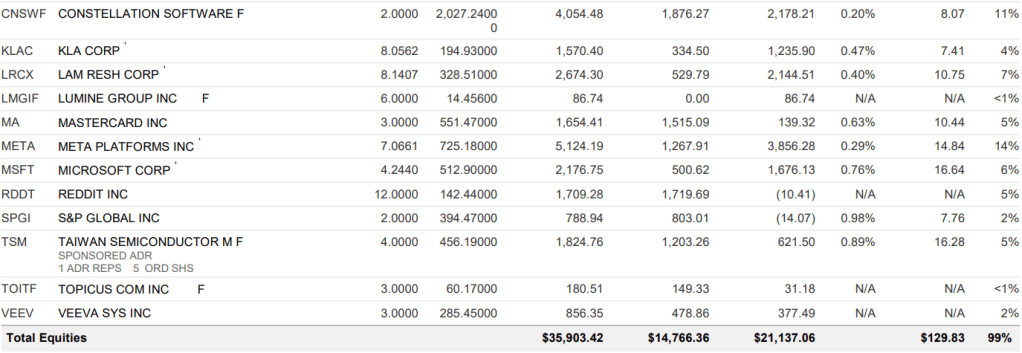
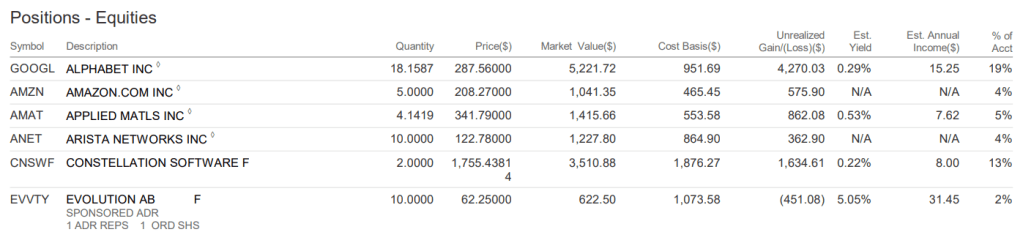
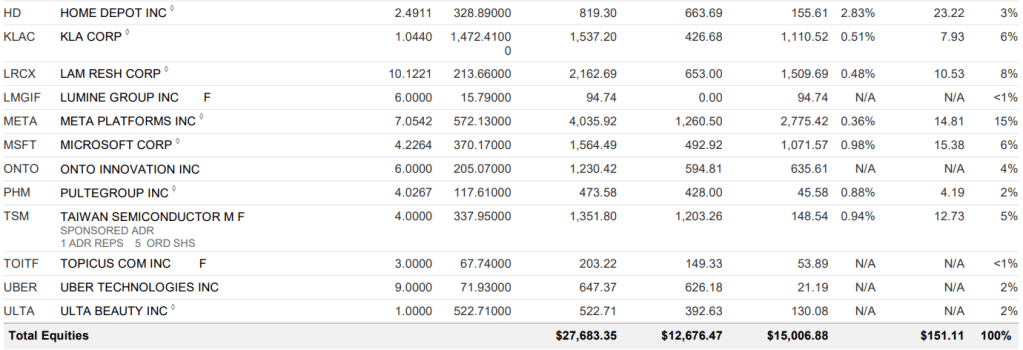
The third quarter was another unusually active one for the portfolio, as I exited several positions and added to businesses where I see more attractive long-term opportunities.
Q3 Transactions
Uber Technologies (UBER) — Sold
I decided to exit my position in Uber, largely due to concerns surrounding the future of autonomous driving. Uber has built an extraordinary business, but I find it increasingly difficult to predict what that business might look like ten years from now.
Will autonomous vehicles strengthen Uber’s position as a platform connecting riders and vehicles, or will companies like Waymo and Tesla increasingly bypass Uber altogether?
I certainly don’t know the answer, and Uber may very well continue to thrive. But the uncertainty surrounding its long-term competitive position was enough for me to move on.
Mobility Global (MBGL) — Sold
Mobility Global was a small position received through a spinoff from S&P Global. I had little interest in maintaining such a small holding and decided to sell the shares to free up capital for other investments.
Reddit (RDDT) — Added
I increased my position in Reddit during the quarter as I’ve become increasingly impressed with the company’s business model and long-term prospects.
Reddit occupies a rather unique position on the internet, with an enormous collection of communities and user-generated content that would be exceptionally difficult to replicate. I believe there remains considerable opportunity to improve advertising monetization while continuing to grow its user base.
The growth numbers are outstanding and I saw an opportunity to make Reddit an increasingly larger position in my portfolio.
Ulta Beauty (ULTA) — Sold
I also exited my position in Ulta Beauty, a company I continue to admire.
Ulta remains an excellent business with a strong competitive position in beauty retail. However, I believe its growth opportunities are more limited than those of several other businesses I’ve been following.
This was less a reflection of anything wrong with Ulta and more a decision to redeploy capital into an investment I believe offers greater long-term upside.
Broadcom (AVGO) — Bought
The most significant new investment during the quarter was Broadcom, where I established a sizable position.
While Nvidia has undoubtedly dominated the conversation surrounding artificial intelligence, I believe Broadcom is emerging as one of the most interesting alternatives in AI computing.
Broadcom specializes in developing custom AI accelerators, often referred to as XPUs, for some of the world’s largest technology companies. Unlike Nvidia’s more general-purpose GPUs, these chips are designed around the specific workloads and requirements of individual customers, potentially offering considerable advantages in cost and efficiency.
Companies like Google are increasingly investing in their own custom silicon to reduce dependence on Nvidia and better optimize their enormous AI infrastructure investments. Broadcom has become a critical partner in that effort, developing custom processors while also supplying the networking technology necessary to connect them.
The growth has been extraordinary. In its latest quarterly earnings report, Broadcom reported AI semiconductor revenue growth of 221% year over year, reaching $16.7 billion. Management expects that figure to increase further in the coming quarter.
I don’t expect Nvidia’s dominance to disappear anytime soon. But the AI computing market is becoming enormous, and Broadcom doesn’t need to displace Nvidia to build an extraordinarily profitable business.
As the hyperscalers continue spending staggering amounts of money on AI infrastructure, I believe Broadcom is exceptionally well-positioned to capture a meaningful share of that investment.
Of course, much of this optimism is already reflected in the company’s valuation. But given the strength of its competitive position, substantial cash generation, and remarkable growth prospects, I believe the opportunity remains attractive.
As always, I would like to thank you for taking the time to give this a read! Feel free to leave some comments or questions. Best way to reach me is on Twitter/X, follow me @TheGarpInvestor.