2024 Q2 Update

The 2024 stock market continues to surprise, with major indices such as the S&P 500, Nasdaq, and Dow Jones Industrial Average reaching new all-time highs. While valuations continue to stretch, it is hard to determine whether such valuations are appropriate. Although CPI numbers show inflation has cooled, prices are still significantly elevated from years prior. Just compare your current grocery bills to those from five years ago; the change is striking. Despite prognosticator expectations for a market pullback, markets continue to soar. They follow no set path, driven instead by the whims of buyers. 

S&P 500 concentration

A notable trend in 2024 is the increasing concentration within the S&P 500, where the top companies dominate more than ever. This has been a long term multi-year trend, but 2024 has seen an intense uptick in consolidation. 

From this CNBC article. 

This concentration is not inherently good nor bad, but is merely a statement of fact. Concentration is inherently baked into capitalism’s core: capital begets more capital.

These top 10 names are highly valued, but often deservedly so. They are the best companies in the world, growing faster than the average S&P 500 company, with higher returns on invested capital and cleaner balance sheets. Their success is no coincidence; they are fantastic companies run by the world’s best managers. 

However, this concentration does put the market at risk, much like it would a portfolio so heavily concentrated. A significant move in any of these top names will disproportionately impact markets. Should any of these companies fail to sustain their exceptional performance, the resulting fall could be swift, dragging markets down with it. Will that happen? I have no idea, but we all should be aware of the risk.

Opportunities Beyond the Top 10

This extreme concentration has actually hidden much of the damage seen elsewhere in the index. While the top companies’ stocks have lifted markets, many other notable names are at or near 52-week lows. Large well-known quality companies like Starbucks, Lululemon, and Comcast have been significantly impacted.

This situation presents what I believe to be an opportunity for those willing to focus on fundamentals. This is a time to find great companies trading at discount prices. With careful analysis, discerning investors can capitalize on this moment, potentially reaping substantial rewards in the long term. 

Comparison of NVDA to Cisco in 2000

I want to comment quickly on a prevailing narrative I often see. NVIDIA has, of course, been the market’s top performer and deservedly so. I have never in all my years observing the market and following company financials seen a company execute so well. They are increasing revenues, profits, and free cash flow at rates that are unheard of for massive companies. To say that it is impressive, would fail to convey just how amazing their results have been. 


Many pontificate that NVIDIA is a bubble, just waiting for the rug to be pulled out from under them. They compare NVIDIA to Cisco in 2000 right before the dot-com crash. For those unaware, Cisco was the market darling before the crash. They were a high performer, but ended up trading to such a ludicrous multiple, that business results couldn’t possibly make it worth it. They reached a price of $69 in 2000, which turned out to be such a wild price, that now, in 2024, they have still yet to reach back to those lofty heights. Meaning that if you had purchased Cisco stock in 2000 and held your shares, you still would have a negative return even 24 years later.

Meanwhile, an investment into the S&P 500 at the same time, would have nearly quadrupled over the same period. Given NVIDIA’s rapid rise, I understand the comparison, but let’s take a look at some numbers so we can really compare.

Here is a snapshot from Cisco’s 2000 annual report, showing their financial results.


Cisco’s business results were undeniably good. Sales and net income both grew at high rates. Sales were up over 50% in 2000 and net income was up over 30%. They did however issue a significant amount of shares, meaning earnings per share did not rise nearly as fast. 

Now let’s look at NVIDIA’s results from this past quarter. 

I frankly see no real comparison here. NVIDIA is a vastly better business, growing revenue 5 times as fast as Cisco was in 2000 and growing earnings over 10 times as fast. On a per share basis, it isn’t even worth discussing. Cisco grew EPS at 24% in 2000, NVIDIA was up 461% year over year. 


With these kinds of growth rates, it is almost impossible to value NVIDIA too high. If they can keep up even some of this trajectory, almost any price is justified. Now of course the obvious question is how big can they get? Their revenue is driven by other megacap tech stocks AI spending. How high can that spending go? I have no idea. Additionally, you can be certain that every company in the AI arena is gunning for NVIDIA. Intel, AMD, and every other chipmaker are dying to capture some of that business and they will do everything in their power to make it happen. Can they catch up? Probably not anytime soon, but maybe. Apple, Amazon, Meta and so on are all also working on designing and building chips in house. They all see how much money NVIDIA is making, so if they have an opportunity to cut them out of the loop and keep that profit in house, they will do so. The returns are simply too high to let NVIDIA continue unopposed.

For those reasons, I have stayed away from the stock. I am unable to answer any of these questions, but I have assuredly looked on in envy. I have no clue as to where NVIDIA’s business goes from here. Perhaps NVIDIA’s next 24 years will be no better than Cisco’s last 24, but I wouldn’t want to bet against Jensen Huang and did want to point out that it is a rather lazy and poor comparison.

Q2 Performance

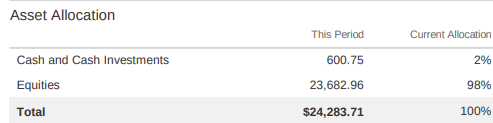
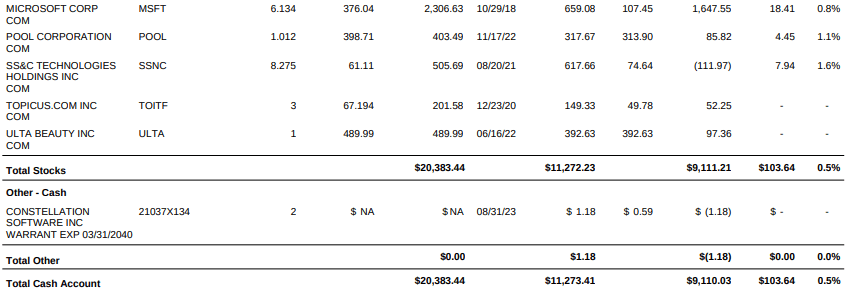
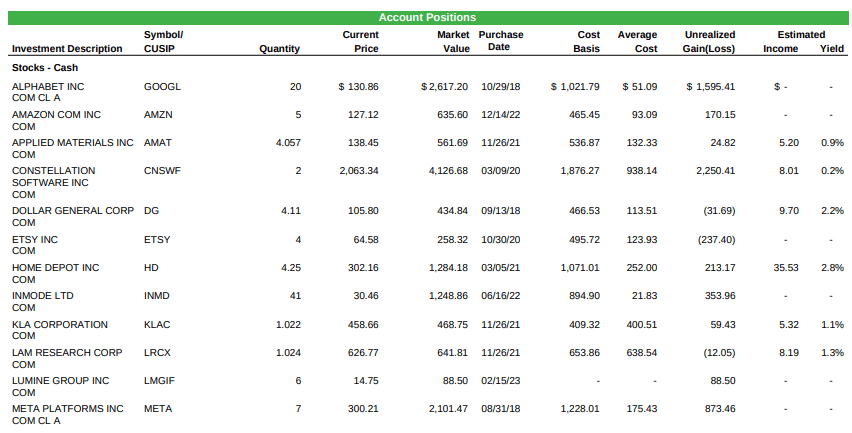
As of 7/1/2024, my 10K portfolio was worth $24,283.71. When I started on 8/19/2018, the SPY had a price of $285.06 and my account started with $10,000. As of 7/1/2024 the SPY had a price of $545.34. In reality, the SPY has done even better due to dividends given out, so I have accounted for dividend reinvestment in the return calculation.

10K Return(1)SPY Return(2)Difference(1-2)
2018(8/19-12/31)(13.95)(13.71)(.24)
201937.3332.64.73
202021.2217.593.63
202138.5528.4310.12
2022(27.25)(18.65)(8.60)
202341.3626.7214.64
2024(1/1-6/30)19.0516.112.94
Since Inception(8/19/18)142.84110.7932.05
CAGR16.3113.552.76

2024 has sustained the positive momentum of my portfolio, both in absolute terms and relative to the SPY. Since its inception, my portfolio has outperformed the SPY by an impressive 32%. This significant outperformance can be attributed to a compounded annual outperformance of 2.76%. It’s a testament to the power of consistent, incremental gains held over extended periods, which can culminate in substantial differences.

Transition To Charles Schwab

You may notice a change in my portfolio’s presentation format, this is due to my recent tradition to Charles Schwab. This change was not voluntary; I originally used TD Ameritrade as my brokerage, but they were acquired by Schwab. The integration took place a couple of months ago, resulting in the transfer. Thus far, I find the Schwab interface less intuitive than that of TD Ameritrade. Over time however, I hope to acclimate. Ultimately, the change is inconsequential, as I retain all of the same holdings and trade so infrequently that platform interface has minimal impact.

Transactions

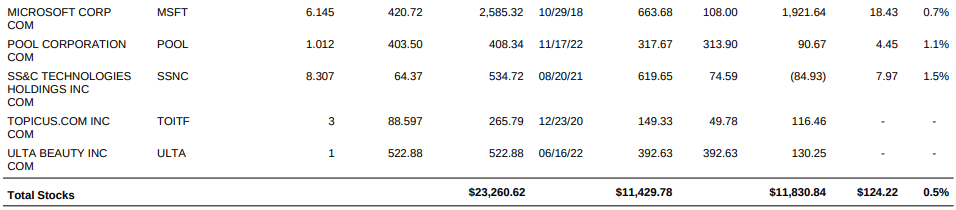
SSNC- At the beginning of the quarter, I decided to liquidate my holdings in SSNC. While I continue to believe in the company’s strong fundamentals and future prospects, I have become increasingly concerned about its balance sheet. SSNC was once a much leaner Operation, a characteristic I found appealing, especially given the current higher interest rate environment. If interest rates remain elevated, the company’s debt load could become a more pressing issue. Additionally, growth has decelerated significantly. SSNC’s reliance on large acquisitions to drive revenue growth will add further debt in the future. Although I have no doubt that SSNC will continue to perform well, I believe reallocating my capital to other opportunities to be the best option going forward.

As always, I would like to thank you for taking the time to give this a read! Feel free to leave some comments or questions. Best way to reach me is on Twitter, follow me @TheGarpInvestor.

2024 Q1 Update

Market enthusiasm sustained its momentum throughout the first quarter of 2024, with stock valuations continuing their upward trajectory. This persistent trend, despite stretching traditional valuation metrics, seems to be bolstered by the anticipated cuts in interest rates, suggesting that such market optimism might have a rational underpinning after all.

A notable observation during this period has been the increasing divergence between what could be termed the “real” economy and the “tech” economy. The real economy, grounded in tangible operations such as manufacturing, logistics, retail, and construction, is showing signs of vulnerability. Revenues and earnings in the “real” economy appear to be in a downturn, putting companies with weak balance sheets at significant risk. As usual, my suggestion would be to stick with companies that can withstand any economic calamity.   

In contrast, the tech sector’s strength is more pronounced than ever. Leading this charge is NVIDIA, alongside the other megacap tech giants who all seem to have reported exceptional financial quarters. NVIDIA in fact, may have produced the single greatest quarter in the history of capitalism. 

Despite my skepticism of the valuation going into earnings season, given the results, it is hard to argue with the moonbound stock performance. It is Jensen Huang’s world, and we are just living in it. I’m the sucker who has never owned any shares, so I’ve just looked on in envy.  

This scenario prompts a critical question: How large can the divide between the “tech” and “real” grow before it becomes unsustainable? It is reasonable to assume that the tech sector’s prosperity is at least somewhat reliant on the broader economy’s health. If traditional businesses are struggling, one might wonder about the sustainability of ad revenues on platforms such as Facebook and Google. How about the demand for advancements in semiconductor technology if the wider economy cannot support these innovations?  

As we look ahead, the economic landscape remains uncertain, yet I maintain a stance of cautious optimism. The market has seen substantial growth since COVID brought on the woes of 2020, suggesting a correction in time is inevitable. Nonetheless, by understanding these dynamics and maintaining a balanced perspective, we can navigate the potential volatility ahead. The juxtaposition of the tech and real economies highlights the need for a nuanced approach to investing, reminding us of the importance of adaptability and prudence in our investment decisions. 

Q1 Performance

As of 4/1/2024, my 10K portfolio was worth $23,311.34. When I started on 8/19/2018, the SPY had a price of $285.06 and my account started with $10,000. As of 4/1/2024 the SPY had a price of $522.16. In reality, the SPY has done even better due to dividends given out, so I have accounted for dividend reinvestment in the return calculation.

10K Return(1)SPY Return(2)Difference(1-2)
2018(8/19-12/31)(13.95)(13.71)(.24)
201937.3332.64.73
202021.2217.593.63
202138.5528.4310.12
2022(27.25)(18.65)(8.60)
202341.3626.7214.64
2024(1/1-3/31)14.2810.823.46
Since Inception(8/19/18)133.11101.1831.93
CAGR16.2713.253.02

As we can see, my portfolio continues to do extremely well, outperforming the SPY on both a short and long term basis. I beat the SPY by 3.46% this past quarter and am up almost 32% on the index since inception. I’m proud of this performance, but of course past performance is not indicative of future results. I can’t afford to become complacent, I need to stay aware of how my companies are performing and what the proverbial threats might lurk around the corner.

As noted before, megacap tech stocks continue to dominate. My investments into GOOGL, AMZN, META, and MSFT have all borne significant fruit. All sit at, or are at least very close to all time highs. This is not a fluke, their business performances have been remarkable and their stocks deserve to be trading at these highs. As noted last quarter, Constellation Software is by far my largest holding, continuing its impressive success. 

Transactions

For the first time in a while, I made a couple of portfolio adjustments. I am generally slow to make any changes, but sometimes a company’s performance, or lack thereof, makes it necessary. 

DG- For a while now, I haven’t loved the results coming out of Dollar General. Following another quarter of disappointing results, I decided to divest from the company. Company’s must earn their spot in the portfolio, past performance does not promise perpetual inclusion.

Dollar General’s growth has slowed in recent years, but more concerning is the compression in margins, Gross margins have held pretty steady, but operating margins have dropped considerably. I want to invest in companies with growing profit margins, not falling. The balance sheet is also in worse shape than it was in years past. 5 years ago DG had under $3B in debt, that now stands at over $6.2B. 

Overall, I think the company sits in a worse financial and competitive position than they did five years ago. They aren’t going anywhere and it would not shock me to see the company return to greatness, but if they do, they will do so without me as a shareholder.

EVVTY- I’ve been following Evolution Gaming for a while now and after a notable stock price drop, I decided to pull the trigger. Evolution is a Swedish juggernaut, a market leader in the live online casino space. Evolution utilizes technology to offer immersive casino services for players from the comfort of their homes. With a strong presence in Europe and expanding global operations, Evolution is a dominant player in the space. 

Financially, there is a lot to like about this company. They grow revenue and earnings each and every year, leading to an ever growing horde of cash. They now sit on a cash balance greater than total liabilities, the kind of balance sheet investors dream about. 

As seen above, operating income has exploded, with extreme operating margin expansion, more than doubling in 6 years’ time. This shows that for every dollar of revenue generated, over 63 cents flows directly into operating profit. You won’t find many companies with this kind of profitability, simply incredible.

As always, I would like to thank you for taking the time to give this a read! Feel free to leave some comments or questions. Best way to reach me is on Twitter, follow me @TheGarpInvestor.
New Years 2024!

Happy New Year to all of my esteemed readers and fellow investors! As we usher in 2024, I find myself looking back on a year that was nothing short of an investment rollercoaster. The year 2023 was marked by shifting sentiments and fluctuating market dynamics, yet it culminated in a strong market upturn, boosting spirits and elevating portfolios to impressive heights. 

2023 kicked off with a renewed sense of optimism. The shadow of COVID-19 appeared to be fading into the past, making way for a new, vibrant normal. The economy was buzzing, but this rapid growth inevitably stoked the fires of inflation. In response, the Federal Reserve implemented a series of interest rate hikes. These measures, initially perceived as a dampener, ultimately proved effective, curbing the rampant inflation and bringing a semblance of balance to the economic landscape. 

The third quarter signaled a turning point in investor sentiment. The Federal Reserve’s efforts, while successful in reining in inflation, might actually have been too potent, casting a shade of apprehension over the economy. The higher interest rates diminished the allure of capital projects. In my own commercial real estate investment business, projects that were attractive at a 3% mortgage rate seemed fraught with risks as rates neared 7%. Across various industries, expansion opportunities dwindled, and for the first time in years, bonds began offering attractive yields, making them a viable alternative to equities.

In the fourth quarter however, we witnessed a dramatic resurgence in the markets. Interest rates appeared to have reached their zenith, sparking a robust recovery in the markets. Consumer confidence, apparently as resilient as ever, played a crucial role in this turnaround. The S&P 500 ended 2023 just a few points shy of its all-time highs.

Looking ahead into 2024, we find ourselves at a crossroads of opportunity and caution. The market’s recent rebound is a beacon of hope, yet it also serves as a reminder of the inherent uncertainties in investing. The coming year promises new challenges as well as opportunities. If interest rates drop back a bit as expected, strategies will shift and so too will markets. 

As investors, our focus should be on staying informed, adaptable, and prudent. Diversification, always a key tenet of successful investing, will remain a cornerstone of my strategy. It is essential to balance the pursuit of growth with the wisdom of risk management. That being said, I believe in letting my winners run. I don’t sell a company for being successful, I prefer to let the market reward elite execution.

Here is to a prosperous 2024. Let’s approach our investment decisions with a blend of optimism, diligence, and a keen eye on changing market dynamics. I wish you all a wonderful year and continued success in all financial endeavors!

Q4 Performance

As of 1/1/2024, my 10K portfolio was worth $20,398.32. When I started on 8/19/18, the SPY had a price of $285.06 and my account started with $10,000. As of 1/1/2024 the SPY had a price of $475.31. In reality, the SPY has done even better due to dividends given out, so I have accounted for dividend reinvestment in the return calculation.

10K Return(1)SPY Return(2)Difference(1-2)
2018(8/19-12/31)(13.95)(13.71)(.24)
201937.3332.64.73
202021.2217.593.63
202138.5528.4310.12
2022(27.25)(18.65)(8.60)
202341.3626.7214.64
Since Inception(8/19/18)103.9882.5521.43
CAGR14.2211.882.34

Reflecting on 2023, I am excited by the success we’ve witnessed, both in the broader market and within my own portfolio. My portfolio’s performance this year has been nothing short of extraordinary, surpassing the SPY by nearly 15%, with a 21.43% outperformance since inception. While such remarkable returns are not something I count on repeating indefinitely, I would certainly welcome them with open arms should they occur. However, it’s wise to remember, as Warren Buffett often reminds us, “The stock market is designed to transfer money from the Active to the Patient.”

This year, mega-cap technology stocks have been the standout performers, just as they have been the trailing decade. My investments in this sector, GOOG, AMZN, MSFT, META, have borne significant fruits, contributing substantially to the portfolio’s impressive growth. Constellation Software now constitutes nearly a quarter of my total portfolio. Conventional Wall Street wisdom might suggest a rebalancing strategy, redistributing assets to reduce concentration. Yet, I disregard such recommendations. The ascent in the stock is a testament to the performance of the underlying business. While some may argue the valuation is stretched, I am prepared to embrace any temporary pullbacks as part of the journey. I’m not betting on the next year, but on what will be 5, 10, and 20 years down the line. 

This past quarter has continued in the same vein as previous ones, with no transactions in my portfolio. This steadfast approach may not be the most exhilarating, but it is the tactic that works for me. By investing in top-tier businesses globally, I place the growth of my investments in the hands of those who know their companies best – the operators. 

However, even the most carefully curated portfolio encounters challenges. A few stocks in my holdings have raised concerns, not due to a dip in their share prices, but rather because of their business performance. Dollar General, for instance, has been a particular laggard. The company seems to have hit a plateau in revenue growth, and its margins are facing increasing pressure. Additionally, the rising interest rates have started to weigh on the balance sheet, with growing interest expenses affecting profitability. 

The decision making process in such scenarios is intricate. If Dollar General’s stock had remained stable while the business fundamentals deteriorated, the choice to sell would be straightforward. The stock however has mirrored the company’s declining business performance, making the decision more complex.

In my past experiences, I’ve learned that acting too hastily when a solid business encounters temporary setbacks can be premature. Allowing a company time to demonstrate its resilience is often a wise strategy. The critical task is to discern whether the issues faced are short-term hurdles or indicative of a longer-term decline. This judgment is where astute analysis becomes invaluable, distinguishing a reactionary decision from a strategic one.

With that I’d like to once again wish you all a happy new year. I would also like to thank you for taking the time to give this a read! Feel free to leave some comments or questions. Best way to reach me is on Twitter/X, follow me @TheGarpInvestor

2023 Q3 Update

The first half of 2023 appeared bright and rosy, with soaring markets and unwavering investor confidence. My own stock portfolio saw impressive gains, and I felt like I was riding the crest of the investing wave. However, the third quarter unveiled the first cracks in this seemingly endless exuberance. While I’ve long foreseen a market correction, it seems my crystal ball is no match for Nostradomus; it took nearly three years for my prediction to materialize. Investors now find themselves rattled, and the prevailing sentiment has shifted to one of impending doom and gloom. As the adage goes, things are never quite as wonderful as they appear, but they are also never as dire as they may seem. 

In the spirit of this investment blog, I’ll refrain from delving into global politics and the ongoing Middle East conflict. Suffice it to say, recent events have cast a heavy shadow, making the past week particularly challenging for me. Writing about seemingly inconsequential topics like investing becomes a tough endeavor when family and friends are living in the middle of a warzone. 

Nevertheless, let’s refocus our attention on the matter at hand. The current market is under the influence of a rising interest rate environment. Rates impact on investments are akin to a gravitational pull, they change the entire framework. Assets that once seemed like bargains in a 3% interest rate scenario suddenly appear expensive when rates climb to over 7%. The question every investor must confront is whether it’s worth the risk to invest in stocks when they can purchase treasuries yielding over 5% at the moment.  

It is evident that some stocks have taken a substantial hit, while others have demonstrated remarkable resilience. Notably, small and micro-cap stocks appear to be bearing the brunt of this downturn, whereas large and mega-cap equities have held their ground. Perhaps there is wisdom in considering a shift from the latter to the former, although personally, I won’t be making such changes. There is however certainly merit to considering a rebalancing strategy.

Today, we find ourselves at an intriguing juncture in time. The Federal Reserve’s efforts to quell inflation seem to be having an effect, but perhaps it is working a little too well. Companies are reporting relatively weak quarterly results, with falling revenues and earnings becoming all too common. Yet, I’ve never been more convinced that investing in outstanding companies offers the best defense in such circumstances. Owning businesses that can leverage a downturn to expand their market share, utilize their cash reserves to buy back shares, and take advantage of lower valuations by acquiring other companies represents a sound investment strategy. 

As we navigate the current landscape, it is important to remember that the stock market is a long term proposition. Short term volatility, driven by shifting interest rates and economic uncertainties, is par for the course. While some investors may be tempted to jump ship and seek refuge in seemingly safer investments, it’s worth keeping in mind the wisdom of legendary investor Benjamin Graham. In the short run, the market is a voting machine, but in the long run, it is a weighing machine. In other words, fundamentals ultimately drive stock prices, and patient investors who stick with great companies during challenging times tend to reap the greatest rewards. 

Q3 Performance

As of 10/1/2023, my 10K portfolio was worth $17,800.14. When I started on 8/19/18, the SPY had a price of $285.06 and my account started with $10,000. As of 10/1/2023 the SPY had a price of $427.48. In reality, the SPY has done even better due to dividends given out, so I have accounted for dividend reinvestment in the return calculation

10K Return(1)SPY Return(2)Difference(1-2)
2018(8/19-12/31)(13.95)(13.71)(.24)
201937.3332.64.73
202021.2217.593.63
202138.5528.4310.12
2022(27.25)(18.65)(8.60)
2023(1/1-9/30)23.4413.519.93
Since Inception(8/19/18)78.0063.5214.48
CAGR13.5910.102.21

Despite my somewhat disheartened tone earlier, 2023 has in fact, been a remarkably successful year for my portfolio. Year to date, I’ve seen gains of over 23%. Admittedly, I may have lost a bit of my lead over the SPY, but I can hardly voice complaints when I still lead by 9.93% this year and 14.48% since inception. After five years in this experiment, I can at least acknowledge that I’ve demonstrated a modest degree of proficiency as an investor. I’ve managed to keep my financial shirt and have steered clear of any truly ill advised forays, like meme stocks or massive uses of leverage. 

Nonetheless, five years remains a relatively brief time frame for making a substantial assessment. Genuine compounding, akin to the growth of a mighty oak from a humble acorn, requires the patience of a lifetime. The greatest rewards take decades to manifest. If I can simply maintain an annual outperformance of just a couple of percentage points, it will ultimately lead to a remarkable accumulation of wealth over the long haul.  

Once again, I can declare that I refrained from making a single trade within my portfolio throughout the quarter. That very well might change this upcoming quarter however. Market turbulence can usher in promising opportunities. Thus, it should come as no surprise if I opt to make some transactions during the final quarter of 2023. 

As always, I would like to thank you for taking the time to give this a read! Feel free to leave some comments or questions. Best way to reach me is on Twitter, follow me @TheGarpInvestor.

2023 Q2 Update

Allow me to begin with a humble apology for the delayed release of this update. Regrettably, a mishap befell my poor laptop just as I started crafting this update. I unfortunately broke my laptop, then had to wait for Amazon to deliver my new one before I could continue writing up this update. If you ever got the impression that I was intelligent, just know that I am incredibly clumsy and broke my laptop in an incredibly foolish way. I was sitting up in my bed with my laptop open next to me. I felt a sudden urge to stretch out my arm and as I thrust out my hand, I somehow managed to punch directly into the screen, breaking it instantly. While I was understandably upset with myself, I couldn’t help but laugh at the absurdity of the situation. 

Nevertheless, another quarter down, another quarter of unexpected market resilience. The market continued its triumphant march forward and economic data continues to come in strong. I must confess that I am awful at predicting the future. My yearlong forecast of a market downturn again looks premature. Thankfully, I possess the wisdom to refrain from acting act on such predictions, allowing my portfolio to grow and flourish. I just hold my stocks and let the businesses do the work. I invest in high quality companies that can weather any storm, executing in both favorable and challenging times.

Let’s quickly discuss the current investment landscape. Interest rates have continued their gradual rise, though the pace appears to have slowed down. As a result of these rate hikes as well as the swift gains seen in the market, finding enticing opportunities has become quite the challenge. Valuations have stretched and fixed income investments appear more enticing by the day. Fear not however, the market has a habit of rewarding those that exhibit the virtue of patience. Opportunities will present themselves, we just need to be prepared to act when they are revealed.

Now, on to a matter of far greater consequence and utmost importance: the showdown of tech billionaire titans, Elon Musk and Mark Zuckerberg! After months of fighting with words, they have decided to settle the feud with fists. They will brawl in a MMA cage match. Personally, I couldn’t be more excited for this matchup. Watching tech billionaires beat the crap out of one another is exactly my idea of a good time. As for my prediction, my money is on Zuckerberg. The guy is in remarkable physical shape, reportedly winning a Jiu Jitsu tournament. He even posted an elite time in a difficult athletic challenge called The Murph. I can’t guarantee the accury of his time or whether he performed each exercise with proper form, but his dedication to fitness is undeniable

A picture of him training with MMA legends should be all the proof we need. I can’t say the same for Musk, we have all seen the infamous boat photos. I’m hoping for his sake he has gotten into better shape, but I’ll wait for his shredded picture to drop for verification. As if the story needed any more juice added to the fire, Meta dropped an absolute bomb with their Twitter clone, Threads. A direct shot at Elon Musk and Twitter, one meant to cripple them in the midst of struggle. I have no idea if Threads will actually be successful, but with Meta’s resources behind them and Zuckerberg’s deep understanding of social media, I wouldn’t bet against them. I’ll be counting down the days to this showdown. 

Q2 Performance

As of 7/1/2023, my 10K portfolio was worth $18,600.09. When I started on 8/19/18, the SPY had a price of $285.06 and my account started with $10,000. As of 7/1/2023 the SPY had a price of $443.26. In reality, the SPY has done even better due to dividends given out, so I have accounted for dividend reinvestment in the return calculation

10K Return(1)SPY Return(2)Difference(1-2)
2018(8/19-12/31)(13.95)(13.71)(.24)
201937.3332.64.73
202021.2217.593.63
202138.5528.4310.12
2022(27.25)(18.65)(8.60)
2023(1/1-6/30)28.9917.2811.71
Since Inception(8/19/18)86.0068.8517.15
CAGR13.5911.382.21

Q2 went remarkably well for my portfolio, almost unfathomably so. I have crushed the SPY since the new year, beating the ETF by 11.71%. I’m now up on them by 17.15% since inception and trending in the right direction. That of course means my portfolio is likely about to implode, so perhaps steer clear of my companies for a while. If you’re feeling frisky, you could even short my companies just to spite me. I wouldn’t do it if I were you, but someone has to be on the other side of the trade.

Most of my companies were up considerably this past quarter, with the only laggards being Dollar General, Etsy, and Ulta. Both DG and Etsy reported pretty weak quarters, so their falls make sense. I’ll hold my shares for now, but will need to see business recovery if I am to hold my shares indefinitely. Ulta’s business continues to dominate, I see no weakness whatsoever. If the stock falls further, it could soon present a strong entry point.

I actually made zero real transactions during the quarter. In fact, I have only made a single transaction in all of 2023 when I purchased a single share of INMD for $33.90(big spender over here.) This is actually how I prefer to run a portfolio. Assemble a group of high quality companies and then sit back and let them do the work. I would categorize myself as a lazy investor, or as Warren Buffett would say, I exhibit the characteristics of “lethargy bordering on sloth.” As long as the businesses remain strong, there is really nothing for me to do.

As always, I would like to thank you for taking the time to give this a read! Feel free to leave some comments or questions. Best way to reach me is on Twitter, follow me @TheGarpInvestor.

2023 Q1 Update

Did you anticipate a strong performance out of stock market in the first quarter of 2023? If you are like most investors, your answer would probably be no. Despite several alarming developments that could have foreshadowed impending doom, markets continued their steady climb throughout the quarter.

Let’s review a few of the big ticket items from the past quarter that could have caused a market downtown. The most significant event of the quarter was the collapse of Silicon Valley Bank. It has been written about endlessly, you can find a much better synopsis of the situation elsewhere. The rapidity with which the bank failed was staggering and highlighted the fragility of the current economic system. While the banking system managed to avoid calamity, the event underscored how quickly things can unravel. 

Meanwhile, the Federal Reserve maintained its commitment to raising interest rates in an effort to curb inflation. These changes may not be immediately apparent, but they will have a significant impact. In my opinion, the Fed is acting a bit recklessly. Such a sudden increase in rates could throw the entire economy into a deep recession, with untold ramifications. A more gradual rise in rates would be preferable to avoid any catastrophic shocks. This could result in a bit more inflation, but that is preferable when compared to the destruction of the economy.

Moreover, there were numerous tech layoffs during the quarter. Seems like everyone’s favorite tech company has decided to do some spring cleaning this year. Alphabet, Meta, Amazon, Microsoft, Salesforce, Dell, Uber, Twitter… the list goes on and on. Tech companies have made a major commitment to cutting costs, which will leave hundreds of thousands left without high-paying jobs. This will subsequently lead to a drop in their consumption habits that will ripple through the rest of the economy.

Despite all of this upheaval, the market somehow managed to keep chugging along. These events serve as a reminder of the intricacy and unpredictability of the market. As a result, I choose to remain invested for the long term and avoid making unforced errors. I let my companies do the work and continue to compound. 

Anyway, let’s take a look at my first quarter results investing results: 

Q1 Performance

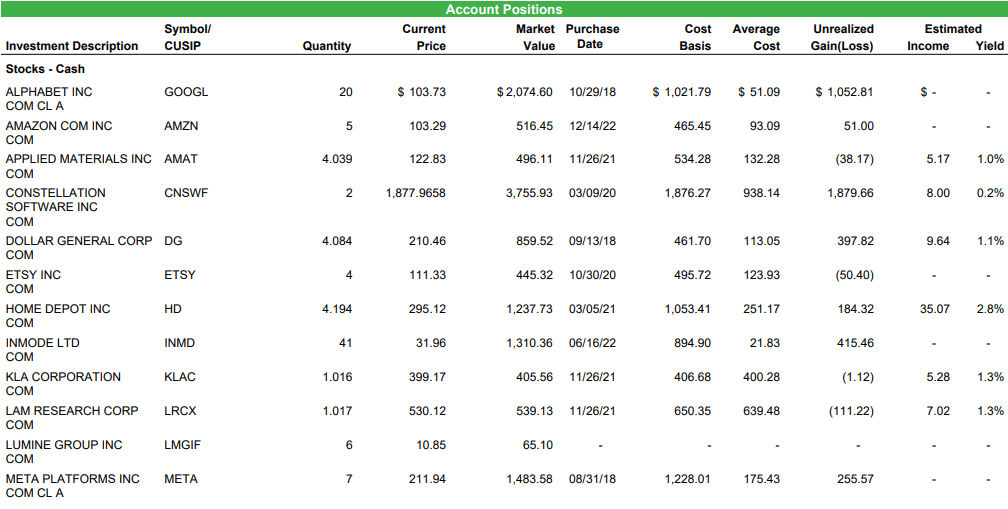
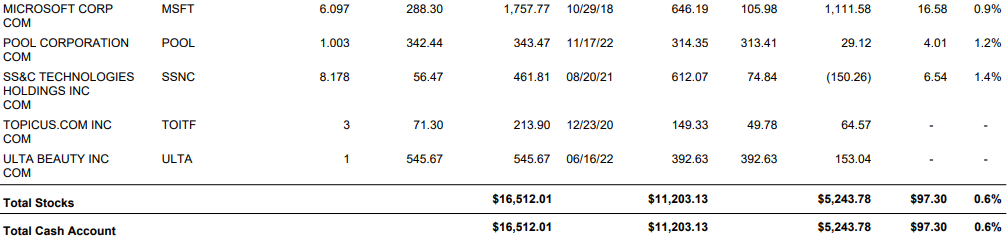
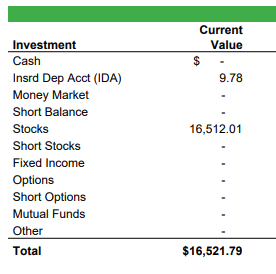
As of 4/1/2023, my 10K portfolio was worth $16,521.79. When I started on 8/19/18, the SPY had a price of $285.06 and my account started with $10,000. As of 4/1/2023 the SPY had a price of $409.39. In reality, the SPY has done even better due to dividends given out, so I have accounted for dividend reinvestment in the return calculation

10K Return(1)SPY Return(2)Difference(1-2)
2018(8/19-12/31)(13.95)(13.71)(.24)
201937.3332.64.73
202021.2217.593.63
202138.5528.4310.12
2022(27.25)(18.65)(8.60)
2023(1/1-3/31)14.587.047.54
Since Inception(8/19/18)65.2255.379.85
CAGR11.5010.031.47

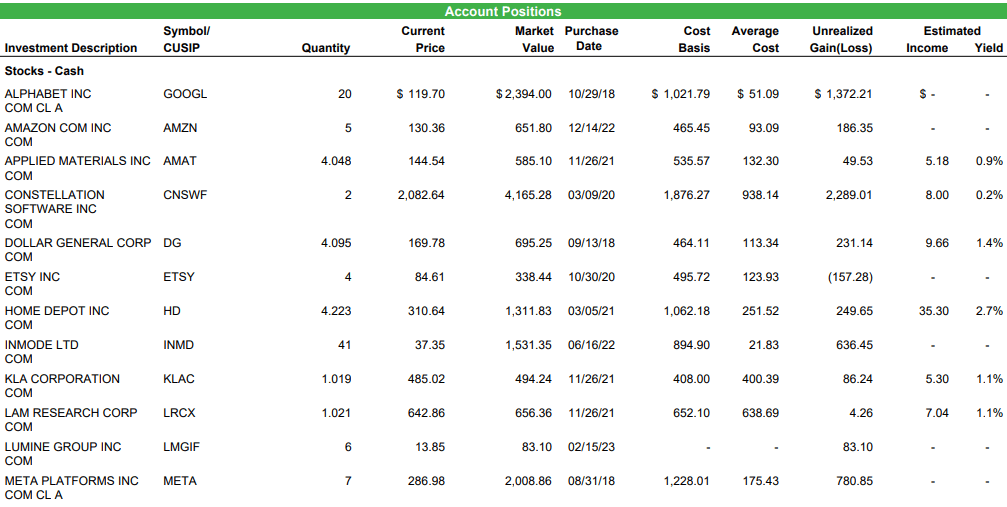
My investment portfolio experienced a robust start to 2023, exceeding the S&P’s returns by over 7.5% thus far. While it would be fantastic to replicate such a feat every quarter, I don’t think I can count on it. I remain pragmatic, but appreciate the strong performance. In particular, I saw a resurgence in some of the Mega Cap tech names such as Alphabet, Amazon, and Microsoft. However, my best performer was Meta. After a never ending stream of bad news, Meta’s stock fell to $120.34 at the end of 2022. By the conclusion of Q1, Meta had risen back up to $211.94. That’s a 76.11% jump in only a quarter. Congratulations to anyone who called the bottom and made a purchase, I unfortunately was not smart enough to have doubled down at a basement price.  

Transactions

I only made two transactions of note during the quarter. First, I bought an extra share of InMode in early January with a tiny bit of cash I had leftover. I continue to be amazed by the company’s impressive performance. The stock currently trades at just about the same price, so it is too early to determine whether this was a wise decision. 

More interesting however was the spinoff of Lumine Group, the newly formed company spun off from Constellation Software. Constellation enacted their second spinout, following in the footsteps of Topicus. I received three shares in the new company for every one share of Constellation. This now gives me six shares in the newly formed company. Too early for me to judge the company, but I consider it a bit of a lottery ticket. This comprises a tiny portion of my portfolio, so will be interesting to follow over the years.

Finally, I continued to DRIP into my dividend paying stocks. These are tiny transactions, but every little bit counts. I’m only scooping up thousandths of a share at a time, but one day these DRIPS will be significant. They will play a big part in the overall returns of the portfolio. 

As always, I would like to thank you for taking the time to give this a read! Feel free to leave some comments or questions. Best way to reach me is on Twitter, follow me @TheGarpInvestor.
2023

Happy new year everyone! The start of the new year is a time to reflect on the past and look ahead to the future. 2022 was a tumultuous year for investing, with markets experiencing volatility and interest rates climbing rapidly. These factors contributed to a decline in asset prices. While the Federal Reserve’s efforts to curb inflation seem to be having some effect, there is no guarantee that the situation will improve. In fact, it is possible that interest rates may continue to rise, putting even more strain on the economy.

It is worth noting that while prices have fallen, there has not yet been a corresponding decrease in earnings. In times of uncertainty, investors and companies tend to become more conservative, focusing on cost-cutting and efficiency rather than growth. This can have a ripple effect on individuals and businesses throughout the economy, as people reduce their spending on non-essential items and industries that rely on consumer spending struggle.

For example, the housing market has been hit hard by the recent increase in interest rates. With monthly mortgage payments now much higher than they were a year ago, potential homebuyers are hesitant to make a purchase. This has led to a significant drop in home sales, which has had a knock-on effect on industries such as real estate, mortgage brokering, and home inspection. As those who work in these fields see their incomes decline, they may be forced to cut back on their own spending, which can then impact other businesses.

It is important to be aware of these potential impacts and to be prepared for any scenario. Building up your savings and making smart investment decisions are always good ideas, and the new year is a great time to review your financial goals and assess whether you are on track to achieve them.

Let’s take a look at my 2022 investing results: 

Q4 Performance

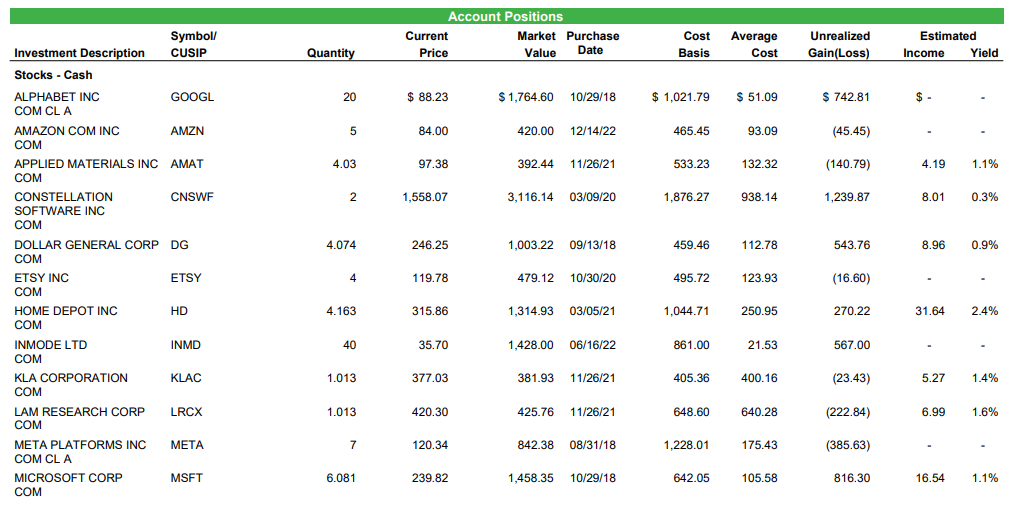
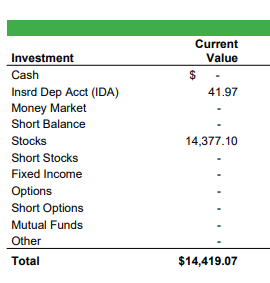
As of 1/1/2023, my 10K portfolio is worth $14,419.07. When I started on 8/19/18, the SPY had a price of $285.06 and my account started with $10,000. As of 1/1/2023 the SPY had a price of $382.43. In reality, the SPY has done even better due to dividends given out, so I have accounted for dividend reinvestment in the return calculation

10K Return(1)SPY Return(2)Difference(1-2)
2018(8/19-12/31)(13.95)(13.71)(.24)
201937.3332.64.73
202021.2217.593.63
202138.5528.4310.12
2022(1/1-12/31)(27.25)(18.65)(8.60)
Since Inception(8/19/18)44.1944.58(.39)
CAGR8.728.82(.1)

While my portfolio underperformed the S&P 500 in 2022, I am happy to see that it has remained relatively close to the index since its inception. Despite the challenges of investing, I am confident in the composition of my portfolio and believe that it will perform well over time. It’s important to remember that investing can be tough, and it’s important to stay humble and cautious. As Warren Buffett has pointed out, as long-term investors, we should actually be hoping for stock prices to go down so that we can buy more shares at lower prices and increase our ownership stakes in the long run.

Transactions

MCO- I sold my shares of Moody’s in early October. This has little to do with the long term prospects of the business, they are still top notch. They will continue dominating their corner of the market, I just thought shares were too expensive and there were better opportunities elsewhere. 

ETSY- I also trimmed my Etsy position, selling off 3 of my 7 shares. I still like the company, but will admit to losing some faith. I think they operate a great business and could have robust growth in their future, but I question management capital allocation. They spent an exorbitant amount buying smaller companies like Depop and Elo7. Maybe these will be good businesses, but they paid ludicrous multiples to buy. Now that the market has tumbled, these acquisitions just look awful. I want to see management commentary after this upcoming quarter, but if I don’t feel confident, I will be selling off the rest of my shares. 


POOL- I bought a single share of Pool Corp in mid December. Pool is the leading distributor of swimming pool supplies and parts. They sell to contractors, pool retailers and pool owners amongst a myriad of others. Distribution is a fantastic business and Pool is second to none. They have fantastic returns on capital and have a lengthy record of consistent success. Simple but immensely profitable business model. 

AMZN- I presume Amazon needs no introduction, but until recently,I had never held any shares. The stock saw a sharp drawdown in 2022, down almost 50% from the start of the year, presenting myself and others with a potentially great opportunity. I think the market is being shortsighted and Amazon is a business unlike any other. They are simply the most dominant business in the world and the one I would least like to compete against. They invest heavily into their business, spending $66B in R&D and $66B in CapEx in 2022. That is a wild amount of money spent in order to widen their moat. Just imagine how dominant they will be 10 years from now. I think they know exactly what they are doing, time will tell.  

AMAT- I decided to pick up another share of Applied Materials in mid December after the stock had fallen 10% in a single day on the back of no real news. I’ve held shares in the company for a bit of time now, so picking up an additional share was a no brainer. Great business with fantastic execution and discipline. 

As always, I would like to thank you for taking the time to give this a read! Feel free to leave some comments or questions. Best way to reach me is on Twitter, follow me @TheGarpInvestor.

2022 Q3 Update

“Investing wise, 2021 couldn’t have gone much better, at least for me. The bull market rages on and markets closed at or near all time highs.” I actually wrote these exact words just nine short months ago. When you put your thoughts out in public, you have to be able to laugh at yourself. I could not have gotten the anticipatory pulse of the situation more wrong. In the time it takes to grow a baby, the investing world has flipped completely on its head. The bear has struck and it looks particularly grizzly. Market sentiment appears to be on the brink of collapse and investor confidence is holding on by a thread.

I am no market prognosticator, if I was, my results would surely be much better. I have no idea which way the market will move from here. Inflation could dampen and markets could come roaring back, wouldn’t that be nice. Just as likely however is that inflation continues to soar, forcing the Fed to continue raising interest rates, which will further compress asset values. I don’t like to sit around forecasting doom and gloom, but it is pretty easy to come up with some spine tingling scenarios we must all be prepared for. 

Most probably do not know this, but in my spare time I enjoy reading fantasy books. My favorite author is Brandon Sanderson, a man well known for writing incredibly long stories with intricate well thought out magic systems. His tome of a novel Rhythm of War, book four of his magnum opus, The Stormlight Archive, contained a scene that helps illuminate the feelings that help me deal with these kinds of periods. 

The protagonist, Kaladin, suffers from a long bitter battle with depression. After suffering yet another crushing blow, Kaladin finds himself on the brink of giving in to his hate. At his lowest moment, a character named Wit comes to him in a vision. Wit is a mysterious character, known for mocking all those around him, but occasionally he lets his callous façade drop and shares his otherworldly wisdom. Kaladin, unsure whether he has the strength to deal with the immense challenges placed upon his shoulders, asks Wit for a story. 

Wit shares the parable of The Dog and The Dragon. It is the tale of a small farm dog who wishes to become a mighty dragon after seeing one soar overhead. Of course in his various attempts to do so, he comes up woefully short. One day however a young child falls into a well. The dog springs into action and as the only one able to fit into the well, he is able to bring a bucket and rope to the child, thereby saving the child’s life. 

Wit stood and stepped over, then put his hand on Kaladin’s back and leaned in. “That night,” he said, “the little dog snuggled into a warm bed beside the fire, hugged by the farmer’s children, his belly full. And as he did, the dog thought to himself “I doubt any dragon ever had it so good anyway.”

He smiled and met Kaldin’s eyes.

‘It won’t be like that for me,’ Kaladin said. ‘You told me it would get worse.’

 ‘It will,’ Wit said, ‘but then it will get better. Then it will get worse again. Then better. This is life, and I will not lie by saying every day will be sunshine. But there will be sunshine again, and that is a very different thing to say. That is truth. I promise you, Kaladin: You will be warm again.’

Rhythm of War pages 920-921

Q3 Performance

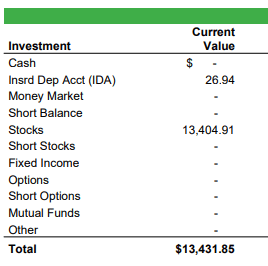
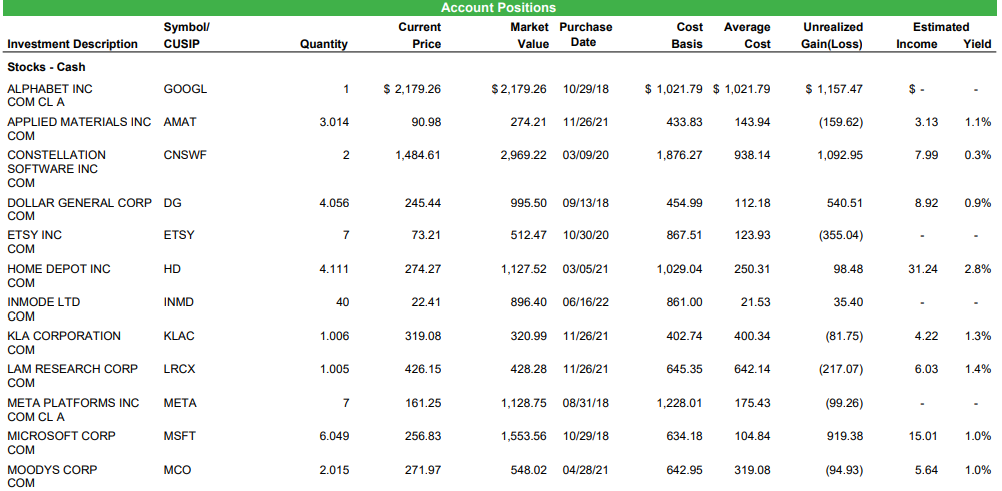
As of 10/1/2022, my 10K portfolio is worth $13,431.85. When I started on 8/19/18, the SPY had a price of $285.06 and my account started with $10,000. As of 10/1/2022 the SPY had a price of $357.18. In reality, the SPY has done even better due to dividends given out, so I have accounted for dividend reinvestment in the return calculation

10K Return(1)SPY Return(2)Difference(1-2)
2018(8/19-12/31)(13.95)(13.71)(.24)
201937.3332.64.73
202021.2217.593.63
202138.5528.4311.52
2022(1/1-9/30)(32.32)(23.93)(8.39)
Since Inception(8/19/18)34.3234.42(.10)
CAGR7.437.46(.03)

Somehow after running this portfolio for a bit over four years now, my performance almost matches the S&P 500 exactly. We are neck and neck, with one leading the other depending on the day you check. Of course on the day I make the tabulation, I am down by .1%. Yes, I’m salty about it. Statistically I’m not even sure this should be possible, but here we are.

Transactions

During the third quarter, I actually didn’t make a single transaction. I kept up my DRIP, so picked up some more tiny fractional shares, but made zero changes to the portfolio. Given how great the market selloff has been, I am starting to see some real opportunities. Don’t be surprised to see a few changes in the 4th quarter update.

As always, I would like to thank you for taking the time to give this a read! Feel free to leave some comments or questions. Best way to reach me is on Twitter, follow me @TheGarpInvestor.
2022 Q2 Update

First off, I’d like to apologize that this update is coming out quite a bit later than I would normally prefer. I was away on a vacation, then had to catch up on work at my business. It has been a particularly stressful period at work and I simply didn’t have the time or mental energy to type up this update.

It is also difficult to write a financial update after a quarter such as this past one. Losing money in investments is heart wrenching. There is no getting around that. It is especially difficult for me, because I have chosen to post my investments publicly and open myself up to ridicule.

I find myself questioning if I really know what I am doing. Am I an imposter posing as a credible investor? Did I do enough investment research or act impulsively? Are the companies I’ve chosen strong enough to withstand an economic recession? Are my investments too correlated and therefore subject to the same risks?

Well, only time will tell us the answers to these questions. In the face of adversity, there is of course only one proper course of action and that is to carry on. Wallowing in sorrow does nothing to improve the situation. Make use of market volatility and kick your research process into high gear and start turning over every stone. Fortunes are won and lost during tumultuous times. Do your best to find yourself sitting on the winning side of the equation. Blood in the streets breeds opportunity. There are high quality companies out there trading at multiples not seen in a decade.

Q2 Performance

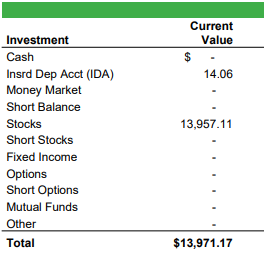
As of 7/1/2022, my 10K portfolio is worth $13,971.17. When I started on 8/19/18, the SPY had a price of $285.06 and my account started with $10,000. As of 7/1/2022 the SPY had a price of $381.24. In reality, the SPY has done even better due to dividends given out, so I have accounted for dividend reinvestment in the return calculation

10K Return(1)SPY Return(2)Difference(1-2)
2018(8/19-12/31)(13.95)(13.71)(.24)
201937.3332.64.73
202021.2217.593.63
202138.5528.4311.52
2022(1/1-6/30)(29.60)(19.61)(9.99)
Since Inception(8/19/18)39.7142.88(3.17)
CAGR9.129.68(.56)

2022 has proven to be an incredibly difficult investing period. My portfolio has gotten crushed, down just a hair under 30% this year. Even worse, I have lost to the market by a rather significant margin. Going into the year I was outpacing the market by a healthy amount, but after a 9.99% loss in 2022, I find myself trailing the S&P since inception. I don’t care so much that my portfolio has gone down, but I do care about losing to the market. Why spend the time and effort if I am unable to beat the index? Let’s hope in the long term this trend reverses and I can get back out on top. 

The economy appears to be on the brink of a recession, with few positives to rely on.. I don’t like to make market predictions, but all indicators are pointing downwards. Is this already priced in? I have no idea. The market could rebound and turn positive in the back half of 2022 or just as easily fall another 20-30%. Rather than try and time market movements, I believe the right course of action is to focus on picking quality companies with high returns on invested capital trading at reasonable prices.

Transactions

NTDOY- In mid June, I decided to make a couple of changes within my portfolio after seeing some particularly attractive opportunities. My portfolio was already fully invested, so I needed a way to raise money. After examining my companies, I determined that Nintendo was the one that had to go.

I sat on a slight loss, so there were no tax burdens to take into account. Actually I will be able to use that loss to offset the gains from selling shares of Dollar General which I will talk about below. I still really like Nintendo and think they have a great future in front of them. They are incredibly profitable with strong margins and boast what is probably the best IP in the entire video game universe. I have just begun to worry about the growth prospects and what the next phase will bring. Growth has gone in the wrong direction and the company has not laid out a roadmap of what exactly to expect in the future. A lot of variables are on the table that have to be taken into account. Don’t misunderstand however, I am still a believer in the company. I continue to own shares in accounts outside of this blog,

DG- I also decided to trim my position in Dollar General. No real problem here, I just needed to raise more cash. Dollar General stock had gone up quite a bit and was trading at a hefty premium to the overall market. I still love the company and want to remain a shareholder, but rebalancing and taking some off the table isn’t the worst outcome. 

ULTA- I have long admired Ulta, but never saw a good opportunity to pick up some shares. Ulta is a very high quality retail chain selling affordable beauty products. This market downturn finally opened up an opportunity to buy Ulta at a reasonable price. As long as I’ve followed them, the company traded for over 30 times free cash flow. Ulta came roaring out of the pandemic, as women could finally go back out in public and beauty products flew off the shelves. I bought Ulta for roughly 18 times free cash flow. They are a remarkably consistent company, growing revenue, net income and free cash flow virtually every year. They operate a simple business model, open high return stores each year and use the free cash flow to repurchase shares. Share count has fallen from 64.65 million in 2015 to 53.94 million today, a 16.57% reduction. 

There is also a longstanding psychological trend called the lipstick effect. In times of recession, women are found to spend money on small indulgences like lipstick and other beauty products, as they forego large expenses like foreign travel or a kitchen redesign. A splurge on a premium beauty product is unlikely to break the wallet, while providing a quick dopamine hit. Given the murky future our economy seems to be heading towards, I feel comfortable holding such a high quality steady company. 

INMD- In mid June I decided I couldn’t wait any longer and pounced on some shares of InMode. On financials alone, I personally cannot find a single company that provides a better opportunity. They check every single box I look for and do so with flying colors. High and growing margins? You bet. Low capital intensity? Only $1 million of CapEx on $170 million in operating cash flow. Strong balance sheet? $400 million in cash against only $61 million in total liabilities, not just debt. Ex-cash, the company trades for about 10 times trailing twelve months free cash flow.

Where’s the rub? Well, InMode sells minimally invasive medical products. If you are an astute reader of mine, you will know that I am not a medical doctor. In fact, I have absolutely no medical training at all whatsoever. I can’t really tell you what their products do, or how they compare to their competitors in the market. Could their products become outdated and replaced in the future? Sure. Could a competitor create a superior product and replace them as a market leader? Definitely. All I know is that the market can’t seem to get enough and sales are exploding. If I had to pick one company that I think has a good chance of becoming a 10 bagger, InMode is the one. Perhaps I am foolish for betting on a company with these kinds of unknowns, but I’m willing to risk it.  

As always, I would like to thank you for taking the time to give this a read! Feel free to leave some comments or questions. Best way to reach me is on Twitter, follow me @TheGarpInvestor.

2022 Q1 Update

Well, that was an interesting quarter to say the least. The Omicron variant of the coronavirus quickly ran its course and the pandemic finally looked to be coming to a close, giving us all a glimmer of hope. Vladimir Putin however decided the world hadn’t seen enough turmoil. The war in Ukraine has thrown the entire globe into a state of disorder. I don’t want to opine on current events politically, but from an investment perspective this war has had a number of impacts.

Given the sanctions placed on Russia, we have seen a rapid rise in the price of oil. We all see it at the gas pump, but maybe more importantly this has put a further strain on the already tight global supply chain. The price of shipping has skyrocketed and the cost of moving product is now astronomical. As an American, it calls into question our reliance on foreign imports. The Biden administration has put an emphasis on American made products to reduce this reliance. Combined with rising interest rates and general inflationary pressures, markets look murky at best.

We saw a quick drop in all markets at the beginning of the quarter followed by a small recovery towards the end of March. Should the war escalate and more countries join the fray, expect continued volatility throughout global markets. My portfolio of course did not escape the quarter unscathed. Things could have gone a whole lot worse, but it is never fun losing money. I take solace knowing my portfolio is filled with strong companies. They make use of market downturns by buying back lower priced shares and eating up market share from weaker competitors.

Q1 Performance

As of 4/1/2022, my 10K portfolio is worth $16,801.98. When I started on 8/19/18, the SPY had a price of $285.06 and my account started with $10,000. As of 4/1/2022 the SPY had a price of $451.64. In reality, the SPY has done even better due to dividends given out, so I have accounted for dividend reinvestment in the return calculation.

10K Return(1)SPY Return(2)Difference(1-2)
2018(8/19-12/31)(13.95)(13.71)(.24)
201937.3332.64.73
202021.2217.593.63
202138.5528.4311.52
2022(1/1-3/31)(15.34)(4.63)(10.71)
Since Inception(8/19/18)68.0268.54(.52)
CAGR15.5315.55(.02)

As we can see, I had a rather abysmal first quarter, particularly as compared to the S&P index. I lost by more than 10% in the quarter to SPY. Not great, but it happens. A little disheartening to see that I’m now losing overall since inception. If I cannot outperform the index, why even put all the time into investing. I could just buy the S&P, sit at home playing video games all day and get better results. Ultimately in the long term, I don’t think that will be the case. I’m pretty confident, maybe irrationally so. Over the course of many years and decades, I expect to do meaningfully better than the index. Of course, so too does everyone else. Only results will show the truth.

I had three main losers in the quarter, Facebook, Etsy, and my group of semicap equipment manufacturers(Lam Research, KLA and Applied Materials). All had valid reasons to have fallen, but perhaps the drops are overblown. I personally would buy more of each at these lower prices if I had available cash, but I am fully invested so cannot. I actually have acquired quite a few more shares in other accounts I manage, particularly of the semicap companies which I believe offer very favorable risk/reward ratios.

Transactions

I actually made zero real transactions this past quarter. Correct me if I am wrong, but I believe this is the first quarter since I started this portfolio that I have not made any changes. I like the companies I invest in and at this point I think just sitting back is the right course of action.

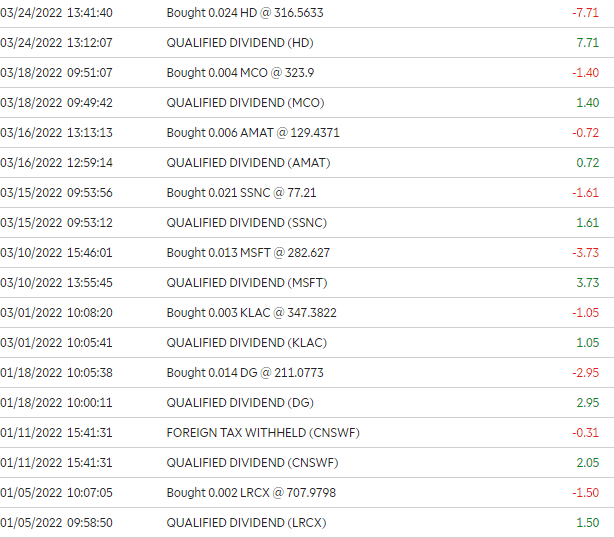
Due to my portfolio DRIP, I did however make a number of very minor transactions. As we can see, my portfolio now makes a handful of purchases automatically due to dividend reinvestment every quarter. These are very tiny purchases, but over time they will add up.

As always, I would like to thank you for taking the time to give this a read! Feel free to leave some comments or questions. Best way to reach me is on Twitter, follow me @TheGarpInvestor.