Q3 2025: More Than a Business

The third quarter of 2025 will be remembered for one thing: the market’s refusal to quit.

Every time it looked ready to correct, it found a way to climb higher. A dip on Monday became a rally by Friday. The bears growled, the bulls shrugged, and the indices marched to new all-time highs. It was the type of market that made skeptics look foolish, and optimists look prescient.

Semiconductors and AI once again led the charge. The spending spree in artificial intelligence is unlike anything we’ve seen in decades; a corporate arms race funded not by speculation, but by companies drowning in cash. Every major tech firm is building data centers the size of small cities, and Wall Street can’t decide whether to call it the next industrial revolution or a bubble prophesied to tank the entire economy. 

Frankly, I don’t know which it is either. There’s something surreal about watching hundreds of billions flow into AI infrastructure, but when the money is coming from balance sheets bursting with cash, it’s hard to call it reckless. When you’re minting $20–$30 billion in free cash flow every quarter, you have to spend it somewhere. And right now, AI is the only story worth telling. With valuations already stretched, share buybacks offer meager yield by comparison.

Elsewhere, inflation cooled slightly, yields eased, and talk of rate cuts returned to the conversation. Investors are once again dreaming of a soft landing, and for now, the dream seems intact.

Still, there’s a quiet tension beneath the euphoria. When everyone’s on one side of the trade, history has a way of humbling the crowd.

The Industrial Hangover

Beneath the surface of market euphoria, the real economy looked tired.

Freight and industrial activity continued to lag, showing none of the exuberance seen in tech. Truckload volumes remained weak, pricing stayed soft, and carriers kept exiting the market. Trucking is a bellwether for the broader economy, so when truckers suffer, it is rarely a good omen.

Manufacturing data told a similar story. New orders cooled, backlogs thinned, and companies quietly pushed out CapEx plans. The industrial engine of the economy is idling, even as markets behave like we’re in a boom.

AI and semiconductors can only levitate the indexes for so long. Eventually, for the economy to hum, there needs to be goods to move. And right now, the people who actually move them are still waiting for the recovery to arrive.

In Memory of My Father

This quarter wasn’t just about markets, it was about loss. Unfortunately, my father passed away in mid-August, and life hasn’t been the same since.

He taught me everything I know, about business, yes, but more importantly about life. How to think independently, act with integrity, and treat people with respect. To him, every action was personal and every moment a lesson. He believed in fairness, in treating others the way his own immigrant parents would have wanted to be treated. That philosophy shaped not just the way I work, but the way I try to live. 

My dad was the reason I got into business and investing. He’s the reason I never had to get a “real” job, bringing me into the family business right after college. That gave me the freedom to study the greats: Buffett, Munger, Graham, and Fisher. To build my own investing philosophy. Without his support, guidance, and belief, nothing I do today would have been possible.

But more than that, he’s the reason I care about doing it the right way. He had a deep sense of honor that guided everything he did. He believed business should be tough but decent, that success meant nothing if it wasn’t shared with those less fortunate. He never cared much for appearances or praise; he just wanted to build something lasting and to take care of those around him.

Losing him has been devastating. There’s an emptiness in my days that I don’t think will ever fully fade. But even through the grief, I can feel his presence, in the way I approach a problem, in how I weigh a risk, in the quiet reminder to do things with integrity.

He built more than a business; he built a foundation. One strong enough for his family to stand on long after he was gone. My goal now is simple: to keep building on what he started, with the same integrity, patience, and determination that defined his life.

Q3 Performance

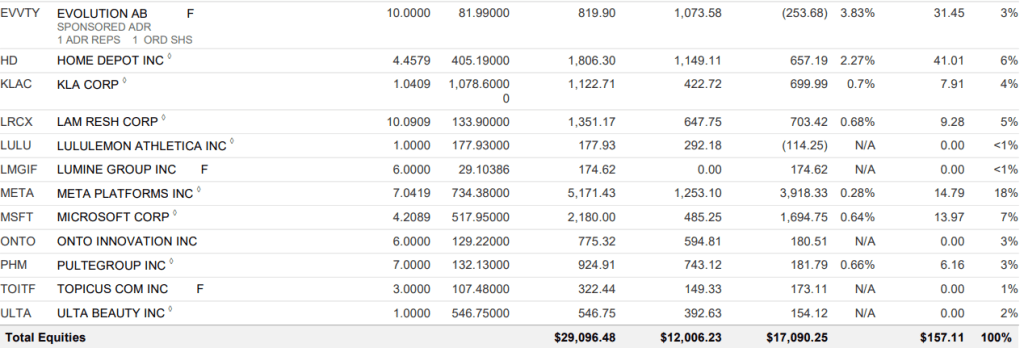
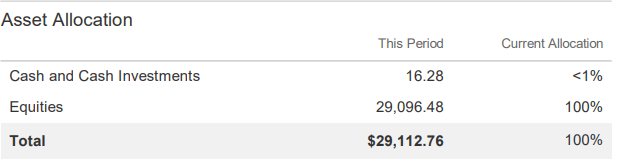
As of 10/1/2025, my 10K portfolio was worth $29,112.76.  When I started on 8/19/2018, the SPY had a price of $285.06 and my account started with $10,000. As of 10/1/2025 the SPY had a price of $668.45. In reality, the SPY has done even better due to dividends given out, so I have accounted for dividend reinvestment in the return calculation.

Year 10K Portfolio SPY Outperformance
2018 (8/19–12/31) -13.95% -13.71% -0.24%
2019 37.33% 32.60% 4.73%
2020 21.22% 17.59% 3.63%
2021 38.55% 28.43% 10.12%
2022 -27.25% -18.65% -8.60%
2023 41.36% 26.72% 14.64%
2024 21.39% 25.59% -4.20%
2025 (1/1–3/31) -5.03% -3.76% -1.27%
2025 (4/1–6/30) 19.11% 10.43% 8.68%
2025 (7/1–9/30) 3.93% 8.52% -4.59%
Since Inception (8/19/18) 191.12% 162.30% 28.82%
CAGR 16.10% 14.50% 1.60%

Quarter three was solid overall, but I trailed the broader market. While the major indexes marched higher, my portfolio moved at a slower pace. A couple of names drove nearly all the results, one on the way up, the other on the way down.
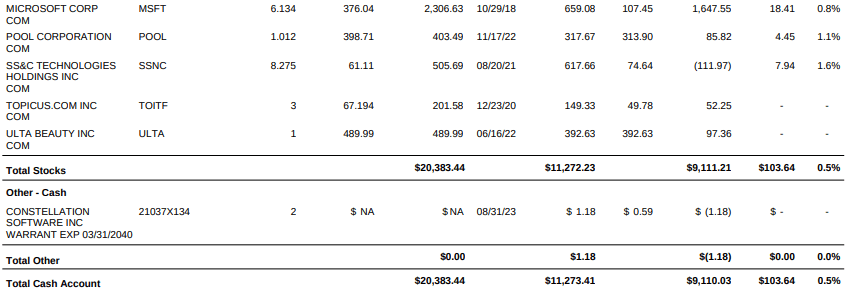
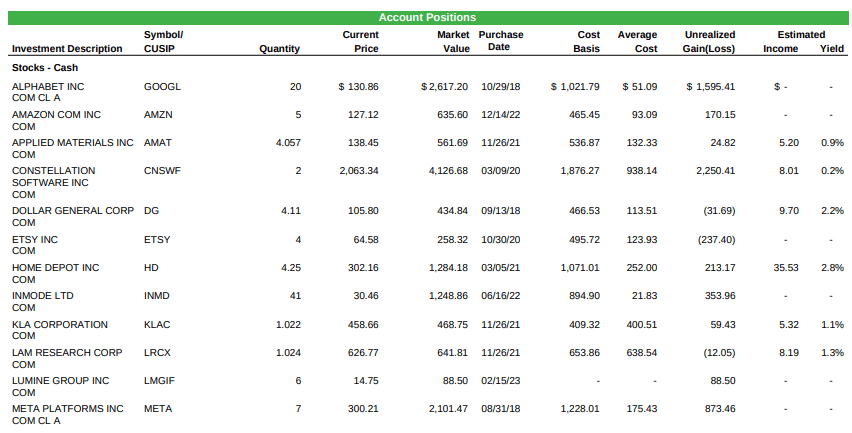
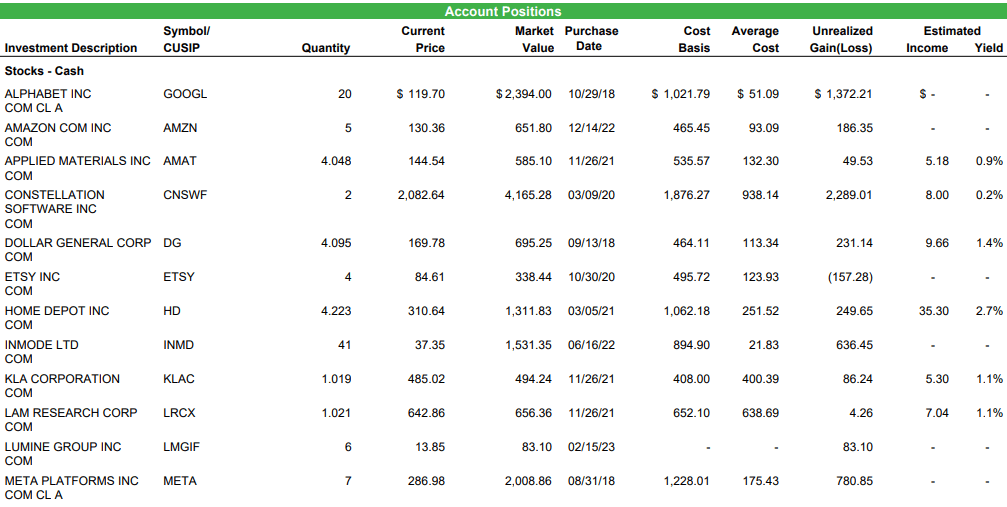
On the bright side, Alphabet (GOOGL) was a star performer. It began the quarter at $176.23 and closed at $243.10, a gain of nearly 38%. For a company of that size, such a move in a single quarter is remarkable. What changed wasn’t the business, it was sentiment. In the spring, investors feared AI might erode Google’s dominance; by late summer, they were convinced it would strengthen it. As usual, the truth probably lies somewhere in between. Alphabet remains an extraordinary company, cash-rich, dominant, and still early in monetizing its AI potential.

On the other side of the ledger was Constellation Software, my largest holding. Constellation dropped from $3,670 to $2,714 a share, a 26% reduction. 

In response to growing investor questions, management held a webcast to address how AI could affect their business. Their tone was measured, cautiously optimistic. They acknowledged that AI could reshape parts of the vertical market software industry, but also emphasized opportunities to integrate it within their own products to enhance functionality and efficiency.

In my view, the real long-term threat isn’t customers replacing Constellation’s software with in-house tools. It is from competitors utilizing AI to create cheaper alternatives, compressing pricing power. That risk remains theoretical today, but over the next decade, it could emerge more clearly. For now, the company’s deep customer relationships, decentralized structure, and disciplined acquisition strategy remain intact.

Then came the tougher news: on September 25th, founder and CEO Mark Leonard stepped down immediately due to health reasons. Details were limited, but the situation sounded serious. I wish him a full and speedy recovery.
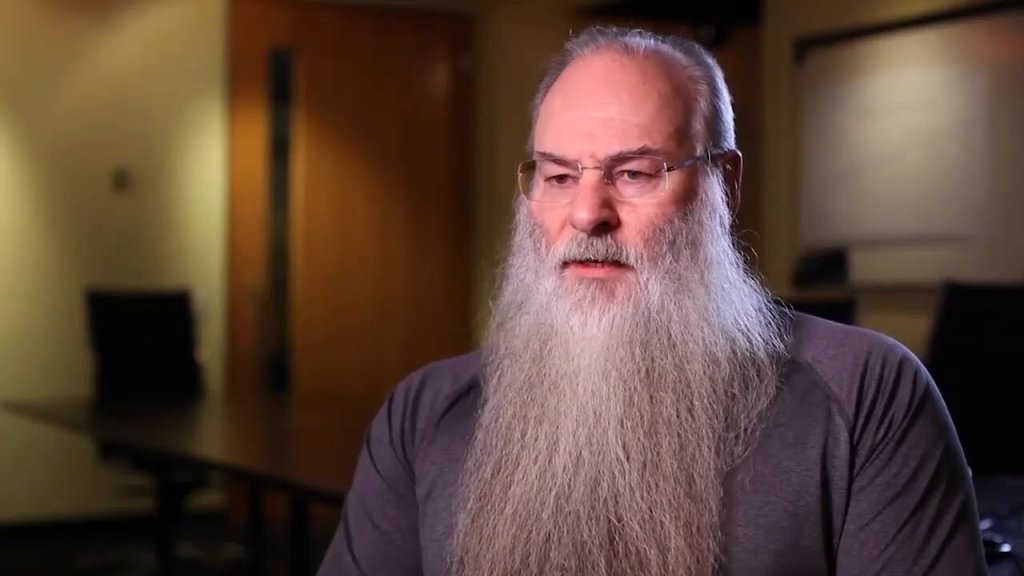
Operationally, little should change. Constellation remains famously decentralized, with capital allocation delegated to hundreds of individual managers. But what the company will miss is Leonard’s quiet wisdom. He had a rare blend of rationality, restraint, and long-term discipline. He built a culture that prized shareholder alignment and focused relentlessly on achieving high hurdle rates. 

Constellation’s next chapter will test whether that culture endures without its architect. My bet is that it will, because the best systems, like the best investments, are built to outlast their founders.

I’m far from the first to notice that Leonard and Buffett stepped down in the same year, but I owe both men a debt of gratitude. Together they’ve shaped my investment philosophy more than anyone else. Each rejected the noise of the moment and instead built patiently for the decades ahead. They rewarded shareholders and turned compounding into an artform. Buffett’s eventual retirement was inevitable, but Leonard’s came as a shock. Still, Constellation will carry on, and every future result will trace directly back to the framework he built.

Q2 2025: Compounding Amid Chaos

The second quarter of 2025 began with a thud.

Markets fell hard in early April, spooked by persistent inflation and the lingering threat of new tariffs. Investor sentiment, already fragile from Q1’s grind, cracked under the weight of more uncertainty. For a moment, it looked like the bottom might give out entirely.

Then, almost inexplicably, the market reversed.

There was no major economic shift. No rate cut. No breakthrough on inflation. But over the course of the quarter, the S&P clawed its way not just back to prior levels, but to fresh all-time highs. It was a rapid climb built on improving sentiment. The panic around tariffs began to ease. Political rhetoric softened and investor confidence soared.  

Markets don’t always need great news to rise. Sometimes, they just need the bad news to stop getting worse.

The Breakup No One Could Have Possibly Seen Coming

Elon and President Trump broke up. They shocked the world, ending the greatest romance of our time. Apparently, when you combine the two biggest egos on the planet, even love isn’t enough.

Of course, we all knew this was coming, it was never a matter of if, but when. And interestingly, it wasn’t President Trump who threw the first punch. It was Elon.

Frustrated by the Big Beautiful Bill’s attack on EV tax credits, and perhaps realizing that DOGE was not as effective as he would have hoped, Elon lashed out publicly. In a now infamous Tweet, Elon claimed Trump to be on the Epstein list. Trump responded in kind, and soon the whole thing devolved into a gloriously public feud.

It’s entertaining, sure, but also meaningful. And while Elon often acts like he’s above politics, he’s very much inside the game. Meanwhile, the President doesn’t take betrayal lightly, so beware what this might mean for any company Elon is involved with. 

So yes, it is a breakup. Yes, it was inevitable. But when the President and the richest man on Earth start taking shots at each other, investors should pay attention. The stakes aren’t just personal, they’re political, financial, and potentially market-moving.

The Magnificent Seven Out of Sync

Once hailed as the dominant engine of the market, the “Magnificent Seven” are no longer moving in lockstep. This quarter brought separation.

  • Apple struggled with slowing sales in China and regulatory scrutiny.
  • Google got dinged by AI concerns and existential questions around the future of search.
  • Tesla continued to bleed, caught between rising EV competition, margin compression, and Elon’s increasingly scattered focus.

That’s the bad news. What about neutral?

  • Amazon as of June 30th, somehow finished the quarter exactly flat (0.0%). Statistically, I’m not sure how that is even possible. I can’t think of a more neutral sign, so the market is telling us Amazon is a hold. 

The winners?

  • Microsoft, Meta, and Nvidia haven’t flinched. Whether it’s cloud, chips, ads, or AI, they continue to dominate, print profits, and drive the index upward with terrifying efficiency.

And while we’re reassessing who really belongs in this elite club, one outsider might be making a push to get included. Netflix. Erasing any doubt, they’ve posted record profits, strong subscriber growth, and flexed pricing power. If there’s room for an “Elite Eight,” they’ve earned a seat at the table.

That being said, I would not bet against any of the Seven, with the possible exception of Tesla, which is clearly the most volatile of the bunch. These are still the biggest, most profitable companies the world has ever seen. Each investing billions to crush competition and deepen their grip on the financial system. They remain the axis around which the market spins. 

Final Thoughts

This quarter was a lesson in patience, again.

The best investment decisions rarely feel good when you make them. Buying in March felt like catching a falling knife. Staying invested through April meant ignoring every bearish headline. But Q2 rewarded those who did nothing. Who endured and who held on. 

It’s tempting to trade the noise, to react, to do something. But most wealth isn’t built by guessing right. It’s built by enduring well. 

There will be a time when markets fall again. There will be more recessions, maybe even another depression someday. But unless the entire economic system collapses, markets recover. They always have.  

Stay invested. Stay patient. Let the noise fade. Time does the rest.

Q2 Performance

As of 7/1/2025, my 10K portfolio was worth $28,010.80.  When I started on 8/19/2018, the SPY had a price of $285.06 and my account started with $10,000. As of 7/1/2025 the SPY had a price of $617.65. In reality, the SPY has done even better due to dividends given out, so I have accounted for dividend reinvestment in the return calculation.

Year 10K Portfolio SPY Outperformance
2018 (8/19–12/31) -13.95% -13.71% -0.24%
2019 37.33% 32.60% 4.73%
2020 21.22% 17.59% 3.63%
2021 38.55% 28.43% 10.12%
2022 -27.25% -18.65% -8.60%
2023 41.36% 26.72% 14.64%
2024 21.39% 25.59% -4.20%
2025 (1/1–3/31) -5.03% -3.76% -1.27%
2025 (4/1–6/30) 19.11% 10.43% 8.68%
Since Inception (8/19/18) 180.10% 141.68% 38.42%
CAGR 16.17% 13.71% 2.46%

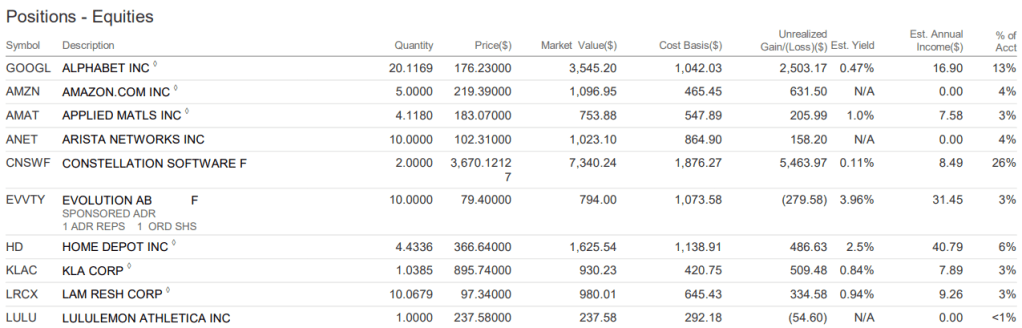
This was surely one of, if not the best quarters I’ve had on record, both in total return and relative to the index. I finished the quarter up 19.11% and beat the SPY by 8.68%. I don’t expect this type of performance to be the norm, it was clearly anomalous, but I’ll gladly take it.

The rally was broad across my holdings. Some of the gains were driven by multiple expansion, but much of it reflects the strength of the underlying businesses. These aren’t speculative names riding hype cycles, they’re durable cash-generating machines with real competitive advantages. I remain hopeful for continued outperformance, but more importantly, continued execution. 

Transactions

MSFT– I trimmed a couple of shares of Microsoft. Nothing dramatic, the company continues to execute exceptionally well, particularly in cloud and AI. But with the stock running hot and the position growing oversized, I wanted to free up some capital for a new high conviction idea. 

ANET- I used that capital to initiate a position in Arista Networks, a business that I believe exemplifies what a modern compounder looks like. 

ANET is one of the most quietly dominant businesses in the market. They’ve taken meaningful market share from Cisco by focusing on high-performance networking equipment, primarily for data centers, and they’re riding major secular tailwinds: AI infrastructure, cloud migration, and enterprise network upgrades.

But what makes Arista truly exceptional is its economics. Gross margins near 65% and operating margins that have gone up every year, now at 42%. Arista has a fortress for a balance sheet, sitting on over $8B in cash, with only $4.4B in total liabilities. Every metric points in the same direction, up and to the right.

Growth has been consistent, capital allocation has been disciplined, and the business scales with impressive efficiency. When I finally found an opportunity to buy it at a reasonable multiple, I pounced. ANET has proven its compounding ability over the past decade, now I’m just hoping they keep the momentum going. 

As always, I would like to thank you for taking the time to give this a read! Feel free to leave some comments or questions. Best way to reach me is on Twitter, follow me @TheGarpInvestor.

Q1 2025: Tariffs and Turbulence

The first quarter of 2025 was a test of patience. It wasn’t dramatic, but it was draining. Markets didn’t crash, they just quietly slid lower, day after day, until doubt began to mount in investors’ confidence. There was no headline moment, just a slow erosion of optimism.

Then, just as the quarter ended, everything changed.

New tariff threats and a sudden shift in political rhetoric out of Washington threw gasoline on a smoldering market. Volatility surged. It felt like being tossed around in the open sea with no life raft to reach out to.

This isn’t normal. But it’s not unprecedented either. Markets often move this way: long periods of calm followed by sharp, confusing bursts of chaos. These swings are drastic, but conventional investing wisdom tells us to be brave. In fact, it is likely the most important thing an investor can do. What is that action we can all take to protect our portfolios? Nothing. It feels like we need to act, do something, counteract the downward momentum. But history has been clear: panic selling is the fastest way to destroy wealth.

Warren Buffett has often said that the stock market is designed to transfer money from the active to the patient. The greatest action you can take in moments like these is to stay invested. Even better, keep buying. Keep adding with each paycheck and let time do the heavy lifting.

Tariffs

Trump’s tariff announcements landed like a thunderclap. For months, markets had been pricing in a “business as usual” political environment. Then came talk of sweeping tariffs 10%, 25%, 60%, 90% maybe even more on certain countries and items, and suddenly the calm was gone.

Markets hate uncertainty. But they really hate abrupt, hard to quantify change. And that’s exactly what sweeping tariffs bring. Sudden cost increases ripple through supply chains, pricing models get upended, and companies are left scrambling to adjust. The result? Margin pressure, inflation concerns, and a wave of investor unease. 

To be clear, there’s a certain logic to Trump’s strategy. He wants the Federal Reserve to cut rates, weaken the dollar, and ultimately make U.S. debt easier to refinance. But even if he is correct and tariffs lead to a major uptick in American manufacturing, better trade deals and lower prices for the American people, the way he went about it is ridiculous. There’s no nuance, no predictability, just a tweet here, a threat there, and a market left to pick up the pieces.

AI CapEx

While headlines scream about tariffs and inflation, one of the most important investment stories of 2025 is happening quietly in server farms and substations.

We’re in the middle of an AI infrastructure boom, something akin to the railroads in the 1800s or broadband in the 2000s. The biggest companies in the world: Microsoft, Amazon, Google, Meta, are spending tens of billions to build the physical backbone of AI. That means more chips, more power infrastructure, and more data centers.

AI may still feel like a buzzword to many, but the capital being deployed is very real. If you’re a long-term investor, this is an investment you want exposure to. But picking the winners will be hard, frankly I have no idea who will ultimately be the winners 10 years from now. Therefore, there are a few different ways to get that exposure. You can get exposure through broad market ETFs, or more targeted ones focused on semiconductors or data centers.

Capital Discipline

In uncertain times, investors don’t need excitement, they need reliability. With markets whipsawing on headlines and political posturing, there’s comfort in companies that keep things simple: generate cash, reinvest prudently, and return the rest to shareholders. These aren’t the loudest businesses in the market, but they tend to be the ones you can sleep well owning.

Capital discipline doesn’t mean stagnation, it means focus. Companies with strong balance sheets and consistent buybacks or dividends offer something rare right now: predictability. When so much feels out of control, owning businesses that know how to allocate capital wisely is one of the few defenses you have. No need to guess the next macro turn when your portfolio is built on steady compounding.

Q1 Performance

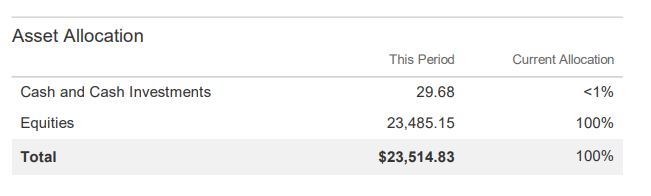
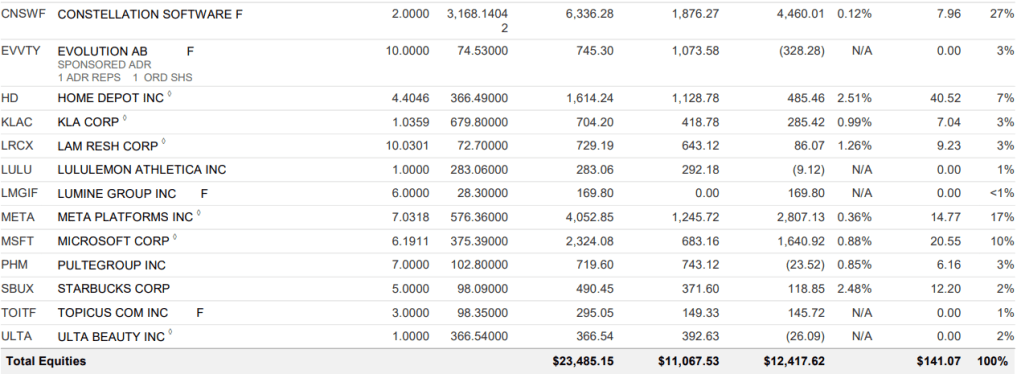
As of 4/1/2025, my 10K portfolio was worth $23,514.83  When I started on 8/19/2018, the SPY had a price of $285.06 and my account started with $10,000. As of 4/1/2025 the SPY had a price of $560.97. In reality, the SPY has done even better due to dividends given out, so I have accounted for dividend reinvestment in the return calculation.

Year 10K Portfolio SPY Outperformance
2018 (8/19–12/31) -13.95% -13.71% -0.24%
2019 37.33% 32.60% 4.73%
2020 21.22% 17.59% 3.63%
2021 38.55% 28.43% 10.12%
2022 -27.25% -18.65% -8.60%
2023 41.36% 26.72% 14.64%
2024 21.39% 25.59% -4.20%
2025 (1/1–3/31) -5.03% -3.76% -1.27%
Since Inception (8/19/18) 133.51% 118.87% 14.64%
CAGR 13.80% 12.56% 1.24%

I underperformed the index in the first quarter, tightening what had previously been a  solid margin of outperformance. I’m still ahead overall, but my CAGR lead has narrowed to just 1.24% gap that could vanish with a few bad days. That’s investing. Progress often comes in zigzags. Still, I remain confident in the businesses I own. Not blindly, but with risk-adjusted conviction based on how they’re actually performing, not just how the stock happens to trade.


INMD- In mid-March, I finally sold my position in InMode. It’s tough to watch a company consistently underdeliver. I’m not concerned with daily stock moves, but I care deeply about business performance, and InMode’s kept heading in the wrong direction. The continued stock decline was no mystery; it was a reflection of weakening fundamentals.

Their business model is particularly sensitive to interest rates. InMode sells high-ticket medical devices, and most of their customers, small clinics and doctors’ offices, finance those purchases. As borrowing costs soared, the ROI on that equipment shrank. What was once a no-brainer purchase became a tough sell. Add potential tariff pressure on top, and the near-term outlook looks cloudy.

If rates return to more attractive levels, I’d absolutely revisit the name. InMode still has a strong model under the right conditions, but for now, the environment is stacked against them.

PHM- This quarter, I initiated a new position in PulteGroup, a homebuilder that, in my view, stands apart in an industry not known for its discipline.

Homebuilding can be a brutal business. It’s cyclical, capital-intensive, and sensitive to rates, labor, and materials. But what drew me to Pulte is how they’ve built a business that respects those realities rather than fighting them. They don’t chase volume. They don’t overextend. They allocate capital with care, prioritize returns on equity, and run a tighter operation than most in the space.

Pulte leans heavily on spec home construction, which shortens build cycles and improves cost control. Albeit, that does introduce some risk, they could be stuck with inventory if demand cools, but Pulte mitigates it by focusing on buyer segments less sensitive to rates, like move-up buyers and retirees. Combine that with a conservative balance sheet and consistent share buybacks, and you get a business that compounds value even when the housing market isn’t on fire.

This isn’t a bet on housing roaring back. It’s a bet that Pulte, even in an average housing environment, can quietly outperform thanks to its operational rigor and capital stewardship. That’s the kind of company I’m comfortable owning for the long haul.

As always, I would like to thank you for taking the time to give this a read! Feel free to leave some comments or questions. Best way to reach me is on Twitter, follow me @TheGarpInvestor.

2024: Reflections and Resilience

The sun has set on 2024 and just begun to rise on 2025, marking the threshold of a new chapter brimming with opportunities, challenges, and, as always, the ever-shifting tides of market sentiment. Reflecting on the year gone by and preparing for the road ahead is a timeless ritual. While we cannot predict the future, we can meet it with preparedness, curiosity, and resilience–traits that have served both investors and dreamers well throughout history.

Costa Rica

I spent a little over a week in Costa Rica around Christmas, and the country’s beauty is truly breathtaking. Towering rainforests alive with vibrant wildlife, pristine beaches meeting turquoise waters, and sunsets that feel like paintings—it’s a place where nature’s magic is on full display.

The Ticos, as Costa Ricans call themselves, embody the spirit of “Pura Vida.” More than a phrase, it’s a way of life—an embrace of gratitude, simplicity, and joy in the moment. Adventure is everywhere, and I made the most of it. I ziplined through lush canopies, hiked to cascading waterfalls, and even raced down what my resort claimed to be the world’s longest jungle waterslide.

But my most unforgettable moment came on a whitewater rafting trip down the Tenorio River. After a steep drop, our raft flipped, and I was thrown into the churning water, trapped beneath the raft as the waterfall above pummeled me. The force of the current was overwhelming, dragging me down no matter how hard I fought to resurface. My life jacket, meant to keep me afloat, seemed useless against the relentless pull of the river. Panic set in as my lungs burned and the seconds stretched into what felt like an eternity.

Just when I thought I couldn’t hold on any longer, a guide grabbed my life jacket and pulled me to safety. Gasping for air, heart pounding, I realized how close I had come to the edge. That moment has stayed with me—a stark reminder of nature’s raw power and life’s fragility. It taught me to cherish the small things—each breath, each heartbeat, each fleeting moment of calm—as gifts not to be taken for granted. Pura Vida isn’t just a saying; it’s a mindset. Costa Rica taught me to appreciate life’s fleeting beauty, a lesson I’ll carry long after leaving its shores.

Markets in 2024: A Tale of Two Realities

The markets demonstrated remarkable resilience in 2024, with indices reaching new highs. Yet, investor sentiment often felt curiously subdued—like a fire that burns brightly but doesn’t radiate warmth. Many approached the market cautiously, bracing for a correction that, for now, remains purely hypothetical. Indices have begun to surrender some of their recent gains, leaving investors wondering whether we are on the verge of a prolonged downturn or merely pausing before another rally.

The truth, as always, is that no one knows. Predictions are easy; preparation is harder. The wise investor focuses not on timing the market but on understanding the businesses they invest in, assessing valuations, and maintaining discipline. The market, after all, has never rewarded haste or fear but has consistently favored those who think long-term, act rationally, and embrace uncertainty as part of the game.

Trump Presidency: A New Economic Chapter

I make it a point to avoid diving into political commentary in this blog. My goal is to keep this space neutral, welcoming readers of all perspectives, not creating division. That said, the policies and platforms of any administration inevitably ripple into the economy and, by extension, the investing universe. Let’s examine what a Trump presidency might mean for the economy and markets over this next presidential cycle

Tariffs and Trade Deals

President Trump’s primary platform revolved around implementing tariffs on foreign goods–a strategy that breaks with decades of economic orthodoxy embraced by both Republican and Democratic leaders. Critics argue that tariffs function as a tax on Americans, raising costs for consumers as importers pass on those increases. While this critique has merit, it risks oversimplification. Tariffs are not merely tools to raise prices on foreign goods, but bargaining chips designed to secure better trade deals and incentivize foreign nations to purchase American goods.

Another dimension of the tariff strategy is its potential to bolster American manufacturing. By increasing the costs of imports, domestic alternatives become more attractive. Of course, the viability of this approach varies across industries. For sectors where American manufacturing is prohibitively expensive, tariffs will have little impact. But in industries where the cost differential is narrow, even a slight shift in incentives could bring production back to U.S. soil. The long-term effects of these policies remain uncertain, I think it is too early to tell what the results might be.

Immigration and the Labor Market

Immigration policy is another cornerstone of Trump’s agenda. The debate reached a crescendo in 2024, with Elon Musk and Vivek Ramaswamy defending the H1B visa program against opposition from within their own party. This clash highlights the nuanced interplay between immigration and economic growth. High-skilled immigrant workers contribute significantly to innovation and industry, while broader immigration policies impact labor markets, demographics, and consumption patterns—all of which ripple through the economy.

Trump’s stance on immigration, particularly on curbing illegal entry, aligns with his broader theme of prioritizing American labor and industry. However, the balance between protectionism and the need for a dynamic, skilled workforce remains a key tension that will shape economic policy in 2025 and beyond.

Q4 Performance

As of 1/1/2025, my 10K portfolio was worth $24,761.42  When I started on 8/19/2018, the SPY had a price of $285.06 and my account started with $10,000. As of 1/1/2025 the SPY had a price of $586.08. In reality, the SPY has done even better due to dividends given out, so I have accounted for dividend reinvestment in the return calculation.

10K Return(1)SPY Return(2)Difference(1-2)
2018(8/19-12/31)(13.95)(13.71)(.24)
201937.3332.64.73
202021.2217.593.63
202138.5528.4310.12
2022(27.25)(18.65)(8.60)
202341.3626.7214.64
202421.3925.59(4.2)
Since Inception(8/19/18)147.61127.9819.63
CAGR15.2713.811.46

Portfolio Performance: Wrapping Up 2024

My portfolio ended 2024 with a bit of a stumble. By the end of the third quarter, I was slightly ahead of the S&P 500, but the fourth quarter erased that lead, leaving me trailing the index by over 4% for the year. Not ideal, but far from cause for alarm. A single year of underperformance is no reason to reconsider one’s strategy—patterns over the long term are what matter most.

Overall, I’m satisfied with how the portfolio has held up. My compound annual growth rate still leads the S&P by nearly 1.5% and sits just under 20% in overall outperformance since inception. Beating the index is no small feat, but I didn’t start this portfolio just to edge out the market. The hope is that this divergence grows meaningfully over time. That said, the index itself has been an exceptional competitor, delivering two consecutive years of 25%+ returns. In such an environment, it’s worth reminding oneself that expectations need to stay grounded. If you’re measuring yourself against perfection, a dose of humility might be in order.

After a busy first three quarters filled with buying and selling activity, the fourth quarter brought a welcome return to stability. I made no portfolio changes, but that doesn’t mean it was uneventful. Businesses are always evolving, and competitive dynamics constantly shift. Let’s dive into how some key holdings fared:

INMD- InMode remains a challenge. The stock continued its downward slide in the fourth quarter, reflecting the stagnation in its growth story. While the company’s fundamentals, particularly its balance sheet, remain impressive, the investment thesis has not played out as hoped. Sitting on $685 million in cash against only $87 million in total liabilities, InMode is in no financial trouble. In fact, it could operate for three years without earning a dime in revenue and still have cash to spare.

This balance sheet gives InMode significant optionality, but the core problem persists: growth has stalled. The company’s reliance on low interest rates has left it vulnerable. Selling high-cost machines to doctors’ offices—a market often reliant on financing—has become a tougher proposition as interest rates remain elevated.

If I were on the board of directors, a role I’ve openly aspired to for any public company, I’d strongly advocate for ramping up R&D spending. InMode’s cash reserves provide ample room to invest in future growth while simultaneously reducing taxable income. Over the past 12 months, the company spent only $14 million on R&D—a figure that could easily be tripled or quadrupled without jeopardizing profitability. Developing new products and diversifying revenue streams would help extend the company’s growth runway and reduce its dependence on economic cycles.

EVO- Evolution had a similarly rough quarter, though the underlying business remains robust. Revenue and margins continue to impress, but regulatory concerns have cast a shadow over the stock. Adding to the turbulence, technical challenges integrating their various platforms have introduced operational headwinds.

The key question is whether Evolution can sustain its current business. Given its extraordinary cash generation and enviable margins, even maintaining the status quo would more than justify the current valuation. If they can navigate regulatory hurdles and deliver even modest growth over the coming decade, the potential for strong returns remains very much on the table.

LULU- Lululemon has been a bright spot. Mid-2024 saw low sentiment around the stock, largely due to Nike’s struggles, which many interpreted as a broader signal of weakness in the athleisure market. Instead, Lululemon has defied expectations, delivering performance.

Revenue and earnings climbed significantly, and the company reduced its share count—a powerful combination under most circumstances. While it’s always tempting to let success breed complacency, Lululemon’s consistent execution in a challenging retail environment is worth celebrating.

Pura Vida!

As always, I would like to thank you for taking the time to give this a read! Feel free to leave some comments or questions. Best way to reach me is on Twitter, follow me @TheGarpInvestor.

2024 Q3 Update

It’s been an eventful third quarter here in 2024. With an election just around the corner, it seems as though every news outlet is gearing up for what they’re calling a decisive moment in history. As usual, we’re told that if the other side wins, it’s the end of America as we know it. Well, here’s a little context: since 1789, we’ve had 46 different presidencies–Democrat, Republican, and even a few Whigs and Federalists thrown into the mix. 

Yet, through each one of these administrations, America has persisted. The stock market, which is sitting at all-time highs today, didn’t get there by luck. It’s a reflection of ever-increasing productivity and the ingenuity of American businesses. Despite the noise, the fundamentals remain strong, and by almost any measure, life is better today than at any other time in human history. 

Now, I’m not blind to the challenges that lie ahead. Our country will face its share of obstacles in both the near and distant future. Illegal immigration, inflation, a crisis in the Middle East, climate change—these are all very real and important issues just to name a few. But no matter who sits in the Oval Office, things have a way of working themselves out. We can sit around mulling over doomsday scenarios, but that doesn’t really get us anywhere. 

Whether the White House belongs to Trump or Harris next year, my investment advice remains the same: invest in quality businesses that earn high returns on invested capital. If picking individual stocks is too hard— and for most, it is not even worth attempting– a diversified selection of low-cost index funds will do just fine. Stick to a sensible plan, avoid the temptation to react to short-term noise, and keep investing steadily over your lifetime. Do that, and the odds of success are overwhelmingly in your favor.

Hurricanes

I’m writing this after yet another major hurricane hit Florida, with Hurricane Milton having made landfall. Thankfully, the damage and loss of life were less severe than feared, but storms of this magnitude are always tragic events. Insurance companies, as usual, will bear the brunt of the financial burden. It will likely take years for claims to be fully settled, and we can expect to see local and regional insurers pushed to the brink, if not into outright bankruptcy. Even some of the world’s largest reinsurers will likely feel the impact.

What’s next for Florida? That’s a tough question. If I were running a major insurance firm, I’d think long and hard before writing any new policies in the state. The risks are simply too high and unpredictable. Insurers are faced with a difficult choice: either pull out of the market entirely, leaving homeowners stranded, or raise premiums to levels that make owning a home unaffordable for most families. Neither option is appealing, and neither bodes well for the future of Florida. And that’s just looking at the residential side. The commercial insurance market, which is critical for businesses, faces its own set of challenges and could be hit just as hard.

The issue is far from simple, and frankly, its one I’m glad I don’t have to solve. It’s going to require a combination of government intervention and innovative solutions from the private sector to keep the state insurable. It’s not an easy fix, but it’s necessary. In the meantime, I wouldn’t fault any insurer for pulling back. Sometimes, when the odds are stacked against you, the smartest move is to walk away. 

Port Strike

A big storyline that flew somewhat under the radar was the East Coast port strike. There was some media coverage, sure, but I don’t think the public truly grasped just how close we came to economic calamity. Thankfully, cooler heads prevailed, and they reached an agreement within 72 hours of the strike beginning. But make no mistake–this could have been a far bigger story. If the ports had been shut down for any significant length of time, the repercussions would have rippled throughout the entire U.S economy. 

Think of the ports as arteries of commerce. A shutdown in port activity doesn’t just impact hte coasts–it brings the entire logistics system to a standstill, creating a logjam that clogs up everything from shipping to trucking to rail. And when the gears of the economy grind to a halt, everyone–from the largest manufacturers to the corner grocery store, feels the squeeze. 


We should all be breathing a huge sigh of relief that a deal was struck, and the prots are back in operation. It’s a reminder of just how fragile and interconnected our economic systems really are. When one piece of the puzzle goes missing, it doesn’t take long before the whole picture starts to blur. 

Q3 Performance

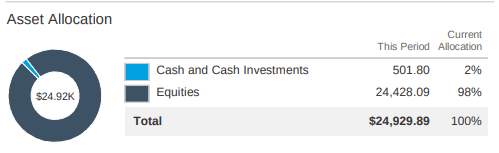
As of 10/1/2024, my 10K portfolio was worth $24,929.89 When I started on 8/19/2018, the SPY had a price of $285.06 and my account started with $10,000. As of 10/1/2024 the SPY had a price of $568.62. In reality, the SPY has done even better due to dividends given out, so I have accounted for dividend reinvestment in the return calculation.

10K Return(1)SPY Return(2)Difference(1-2)
2018(8/19-12/31)(13.95)(13.71)(.24)
201937.3332.64.73
202021.2217.593.63
202138.5528.4310.12
2022(27.25)(18.65)(8.60)
202341.3626.7214.64
2024(1/1-9/30)22.2121.38.83
Since Inception(8/19/18)149.29112.2937
CAGR16.1013.093.01

The third quarter saw only a small change in my portfolio performance. This quarter, my portfolio continued to closely mirror the index, achieving only a marginal outperformance in comparison. It is vital to acknowledge, however, that a tiny outperformance will lead to large differentials over time. I continue to be satisfied with the portfolio’s execution in both actual and relative terms. If you had told that this portfolio would compound at a 16.1% CAGR when I first started this blog, I would never have believed you, but here we are.

2023 saw few, if any, changes to my portfolio. 2024 however has been uncharacteristically busy for me, particularly in this past quarter. I generally recommend not making too many adjustments to your portfolio once it is constructed. I am often an advocate for the “coffee can portfolio” strategy–a long term, buy and hold approach where you set aside funds in a metaphorical coffee can, remaining untouched for decades. But sometimes I think activity is necessary. Quality remains paramount, and when companies no longer meet our high standards, they must be replaced with superior alternatives.

Transactions

SBUX-
Starbucks is a name that needs no introduction. People are addicted to coffee and no one does it better than Starbucks. Under CEO Laxman Narasimhan Starbucks experienced some challenging times. Drink prices had climbed too high, and competition began to eat into its market share, particularly in China, which was supposed to be a key growth driver. Narasimhan appeared to be in over his head, and he struggled to provide effective solutions. His now infamous interview with Jim Cramer left viewers shaking their heads, as he talked about “providing value to customers” without offering any actionable steps. 

In early July, I saw a dip in the price and felt it presented a good opportunity to accumulate shares. Starbucks is a brand with immense staying power, and I believed the challenges it faced were temporary. Even with a subpar CEO, the underlying strength of the brand made it a worthwhile investment. I was betting that a focus on brand protection would lead to long term success and strong returns.

Well so far, my purchase has done extremely well. I had no inkling that Narasimhan would be fired and replaced by Brian Niccol, but I’m certainly pleased with the outcome. Niccol is a restaurant industry veteran, having previously led Taco Bell and Chipotle to impressive heights. Wall Street is confident that he can do the same with Starbucks, as the stock has surged since his appointment. Has the stock gotten a bit ahead of itself? Probably, but I’m in it for the long haul, and these short-term price movements don’t concern me. 

POOL- Now it’s time to confess one of my portfolio’s biggest mistakes. I sold out of Pool Corp shortly after buying Starbucks. Why did I sell? The easiest answer is that I’m an idiot. In all seriousness, I sold due to what I perceived as declining business fundamentals. Revenue in 2023 began to fall, and that trend has continued into 2024. The pool industries going through a rough patch, as many people who wanted a pool installed one during the pandemic, pulling forward years of demand. 

The maintenance side of the business is still performing well, as all those newly built pools now need constant upkeep. This is a great source of recurring, high margin revenue. However, overall sales have dipped.

In hindsight, selling appears to have been a clear error. Pool Corp’s stock is up more than 20% since I exited. I try not to check the price too often, as it’s just a painful reminder. Pool Corp remains a tremendous business, and it dominates its sector. I simply believed I had better opportunities elsewhere. So far, that bet hasn’t paid off. 

LULU- Lululemon has always been a name associated with premium quality, and for years, it commanded a premium valuation. Until recently, it was nearly impossible to buy this brand at a reasonable price. However, recent challenges have caused the stock to take a tumble, offering what may be the first real opportunity in the company’s history for long term investors to buy at an attractive valuation. 

The issues behind the price drop are mainly related to concerns about slowing growth and increased competition. We saw a disappointing quarter from Nike, indicating that apparel and footwear sales are likely to be challenged as rising prices squeeze consumers’ budgets. Despite these headwinds, I believe this has provided an opportunity. Lululemon’s brand equity, loyal customer base, and unique product offerings make it a compelling buy at current levels.

At a fundamental level, Lululemon is a very good business. If you can sell a pair of yoga pants for $100, it’s hard not to generate strong margins. Lululemon boasts nearly 60% gross margins and close to 25% operating margins. For reference, both Nike and Under Armour have gross margins that hover around 45% with operating margins of 12.5% and 4% respectively. That means for every dollar of sales, Lululemon makes double the operating income of Nike and six times that of Under Armour, a testament to its status as a true premium brand.

Growth has also been stellar over the years. In 2016, Lululemon had less than half the sales of UA. Today their sales are nearly double those of UA. Perhaps that is more indicative of UA’s decline than Lulu’s ascendence, but in that same time period Lulu increased sales by almost five times, which for any company is pretty incredible.

In summary, Lululemon’s stock price decline presents a rare opportunity. While the short term may be rocky, the long term outlook for this brand remains bright, as it continues to occupy a unique position in the market. It is a classic example of being able to buy a great business at a fair price, and that’s exactly the kind of opportunity I like to take advantage of.

ETSY- I finally decided to liquidate my holdings in Etsy. Since I initially trimmed the position in 2022, the company’s performance has continued to disappoint. Revenue has flatlined, and Etsy has struggled to find new growth avenues. Has the market simply reached saturation? Or has management failed to connect the right products with the right consumers? Time will tell.

More concerning, however, has been their capital allocation. Etsy made multiple acquisitions at inflated prices and spent on share buybacks at overvalued levels. Capital allocation is critical in any business, and Etsy’s missteps in this area were a major red flag. Unfortunately, I was correct when I first trimmed my position, but I should have sold out entirely. I ended up selling my remaining shares at a 50% lower price than my initial sale. Still, it wasn’t all bad news, as the stock has fallen another 20% since I exited. I’ll root for Etsy in the future, but it will no longer be a part of my portfolio. 

As always, I would like to thank you for taking the time to give this a read! Feel free to leave some comments or questions. Best way to reach me is on Twitter, follow me @TheGarpInvestor.

2024 Q2 Update

The 2024 stock market continues to surprise, with major indices such as the S&P 500, Nasdaq, and Dow Jones Industrial Average reaching new all-time highs. While valuations continue to stretch, it is hard to determine whether such valuations are appropriate. Although CPI numbers show inflation has cooled, prices are still significantly elevated from years prior. Just compare your current grocery bills to those from five years ago; the change is striking. Despite prognosticator expectations for a market pullback, markets continue to soar. They follow no set path, driven instead by the whims of buyers. 

S&P 500 concentration

A notable trend in 2024 is the increasing concentration within the S&P 500, where the top companies dominate more than ever. This has been a long term multi-year trend, but 2024 has seen an intense uptick in consolidation. 

From this CNBC article

This concentration is not inherently good nor bad, but is merely a statement of fact. Concentration is inherently baked into capitalism’s core: capital begets more capital.

These top 10 names are highly valued, but often deservedly so. They are the best companies in the world, growing faster than the average S&P 500 company, with higher returns on invested capital and cleaner balance sheets. Their success is no coincidence; they are fantastic companies run by the world’s best managers. 

However, this concentration does put the market at risk, much like it would a portfolio so heavily concentrated. A significant move in any of these top names will disproportionately impact markets. Should any of these companies fail to sustain their exceptional performance, the resulting fall could be swift, dragging markets down with it. Will that happen? I have no idea, but we all should be aware of the risk.

Opportunities Beyond the Top 10

This extreme concentration has actually hidden much of the damage seen elsewhere in the index. While the top companies’ stocks have lifted markets, many other notable names are at or near 52-week lows. Large well-known quality companies like Starbucks, Lululemon, and Comcast have been significantly impacted.

This situation presents what I believe to be an opportunity for those willing to focus on fundamentals. This is a time to find great companies trading at discount prices. With careful analysis, discerning investors can capitalize on this moment, potentially reaping substantial rewards in the long term. 

Comparison of NVDA to Cisco in 2000

I want to comment quickly on a prevailing narrative I often see. NVIDIA has, of course, been the market’s top performer and deservedly so. I have never in all my years observing the market and following company financials seen a company execute so well. They are increasing revenues, profits, and free cash flow at rates that are unheard of for massive companies. To say that it is impressive, would fail to convey just how amazing their results have been. 


Many pontificate that NVIDIA is a bubble, just waiting for the rug to be pulled out from under them. They compare NVIDIA to Cisco in 2000 right before the dot-com crash. For those unaware, Cisco was the market darling before the crash. They were a high performer, but ended up trading to such a ludicrous multiple, that business results couldn’t possibly make it worth it. They reached a price of $69 in 2000, which turned out to be such a wild price, that now, in 2024, they have still yet to reach back to those lofty heights. Meaning that if you had purchased Cisco stock in 2000 and held your shares, you still would have a negative return even 24 years later.

Meanwhile, an investment into the S&P 500 at the same time, would have nearly quadrupled over the same period. Given NVIDIA’s rapid rise, I understand the comparison, but let’s take a look at some numbers so we can really compare.

Here is a snapshot from Cisco’s 2000 annual report, showing their financial results.


Cisco’s business results were undeniably good. Sales and net income both grew at high rates. Sales were up over 50% in 2000 and net income was up over 30%. They did however issue a significant amount of shares, meaning earnings per share did not rise nearly as fast. 

Now let’s look at NVIDIA’s results from this past quarter. 

I frankly see no real comparison here. NVIDIA is a vastly better business, growing revenue 5 times as fast as Cisco was in 2000 and growing earnings over 10 times as fast. On a per share basis, it isn’t even worth discussing. Cisco grew EPS at 24% in 2000, NVIDIA was up 461% year over year. 


With these kinds of growth rates, it is almost impossible to value NVIDIA too high. If they can keep up even some of this trajectory, almost any price is justified. Now of course the obvious question is how big can they get? Their revenue is driven by other megacap tech stocks AI spending. How high can that spending go? I have no idea. Additionally, you can be certain that every company in the AI arena is gunning for NVIDIA. Intel, AMD, and every other chipmaker are dying to capture some of that business and they will do everything in their power to make it happen. Can they catch up? Probably not anytime soon, but maybe. Apple, Amazon, Meta and so on are all also working on designing and building chips in house. They all see how much money NVIDIA is making, so if they have an opportunity to cut them out of the loop and keep that profit in house, they will do so. The returns are simply too high to let NVIDIA continue unopposed.

For those reasons, I have stayed away from the stock. I am unable to answer any of these questions, but I have assuredly looked on in envy. I have no clue as to where NVIDIA’s business goes from here. Perhaps NVIDIA’s next 24 years will be no better than Cisco’s last 24, but I wouldn’t want to bet against Jensen Huang and did want to point out that it is a rather lazy and poor comparison.

Q2 Performance

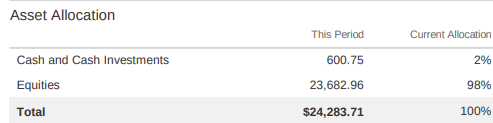
As of 7/1/2024, my 10K portfolio was worth $24,283.71. When I started on 8/19/2018, the SPY had a price of $285.06 and my account started with $10,000. As of 7/1/2024 the SPY had a price of $545.34. In reality, the SPY has done even better due to dividends given out, so I have accounted for dividend reinvestment in the return calculation.

10K Return(1)SPY Return(2)Difference(1-2)
2018(8/19-12/31)(13.95)(13.71)(.24)
201937.3332.64.73
202021.2217.593.63
202138.5528.4310.12
2022(27.25)(18.65)(8.60)
202341.3626.7214.64
2024(1/1-6/30)19.0516.112.94
Since Inception(8/19/18)142.84110.7932.05
CAGR16.3113.552.76

2024 has sustained the positive momentum of my portfolio, both in absolute terms and relative to the SPY. Since its inception, my portfolio has outperformed the SPY by an impressive 32%. This significant outperformance can be attributed to a compounded annual outperformance of 2.76%. It’s a testament to the power of consistent, incremental gains held over extended periods, which can culminate in substantial differences.


Transition To Charles Schwab

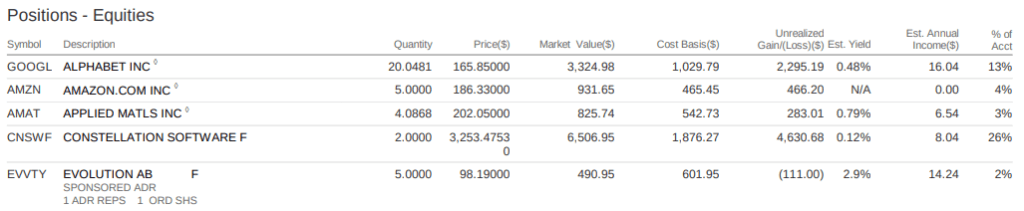
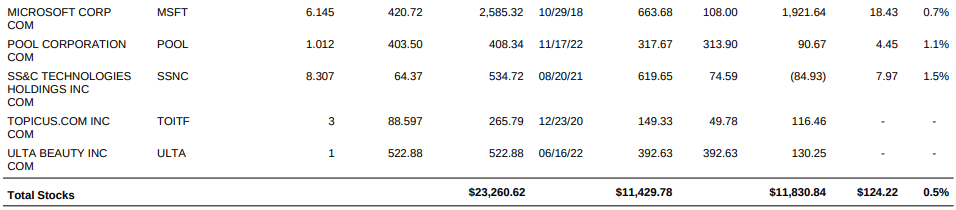
You may notice a change in my portfolio’s presentation format, this is due to my recent tradition to Charles Schwab. This change was not voluntary; I originally used TD Ameritrade as my brokerage, but they were acquired by Schwab. The integration took place a couple of months ago, resulting in the transfer. Thus far, I find the Schwab interface less intuitive than that of TD Ameritrade. Over time however, I hope to acclimate. Ultimately, the change is inconsequential, as I retain all of the same holdings and trade so infrequently that platform interface has minimal impact.

Transactions

SSNC- At the beginning of the quarter, I decided to liquidate my holdings in SSNC. While I continue to believe in the company’s strong fundamentals and future prospects, I have become increasingly concerned about its balance sheet. SSNC was once a much leaner Operation, a characteristic I found appealing, especially given the current higher interest rate environment. If interest rates remain elevated, the company’s debt load could become a more pressing issue. Additionally, growth has decelerated significantly. SSNC’s reliance on large acquisitions to drive revenue growth will add further debt in the future. Although I have no doubt that SSNC will continue to perform well, I believe reallocating my capital to other opportunities to be the best option going forward.

As always, I would like to thank you for taking the time to give this a read! Feel free to leave some comments or questions. Best way to reach me is on Twitter, follow me @TheGarpInvestor.

2024 Q1 Update

Market enthusiasm sustained its momentum throughout the first quarter of 2024, with stock valuations continuing their upward trajectory. This persistent trend, despite stretching traditional valuation metrics, seems to be bolstered by the anticipated cuts in interest rates, suggesting that such market optimism might have a rational underpinning after all.

A notable observation during this period has been the increasing divergence between what could be termed the “real” economy and the “tech” economy. The real economy, grounded in tangible operations such as manufacturing, logistics, retail, and construction, is showing signs of vulnerability. Revenues and earnings in the “real” economy appear to be in a downturn, putting companies with weak balance sheets at significant risk. As usual, my suggestion would be to stick with companies that can withstand any economic calamity.   

In contrast, the tech sector’s strength is more pronounced than ever. Leading this charge is NVIDIA, alongside the other megacap tech giants who all seem to have reported exceptional financial quarters. NVIDIA in fact, may have produced the single greatest quarter in the history of capitalism. 

Despite my skepticism of the valuation going into earnings season, given the results, it is hard to argue with the moonbound stock performance. It is Jensen Huang’s world, and we are just living in it. I’m the sucker who has never owned any shares, so I’ve just looked on in envy.  

This scenario prompts a critical question: How large can the divide between the “tech” and “real” grow before it becomes unsustainable? It is reasonable to assume that the tech sector’s prosperity is at least somewhat reliant on the broader economy’s health. If traditional businesses are struggling, one might wonder about the sustainability of ad revenues on platforms such as Facebook and Google. How about the demand for advancements in semiconductor technology if the wider economy cannot support these innovations?  

As we look ahead, the economic landscape remains uncertain, yet I maintain a stance of cautious optimism. The market has seen substantial growth since COVID brought on the woes of 2020, suggesting a correction in time is inevitable. Nonetheless, by understanding these dynamics and maintaining a balanced perspective, we can navigate the potential volatility ahead. The juxtaposition of the tech and real economies highlights the need for a nuanced approach to investing, reminding us of the importance of adaptability and prudence in our investment decisions. 

Q1 Performance

As of 4/1/2024, my 10K portfolio was worth $23,311.34. When I started on 8/19/2018, the SPY had a price of $285.06 and my account started with $10,000. As of 4/1/2024 the SPY had a price of $522.16. In reality, the SPY has done even better due to dividends given out, so I have accounted for dividend reinvestment in the return calculation.

10K Return(1)SPY Return(2)Difference(1-2)
2018(8/19-12/31)(13.95)(13.71)(.24)
201937.3332.64.73
202021.2217.593.63
202138.5528.4310.12
2022(27.25)(18.65)(8.60)
202341.3626.7214.64
2024(1/1-3/31)14.2810.823.46
Since Inception(8/19/18)133.11101.1831.93
CAGR16.2713.253.02

As we can see, my portfolio continues to do extremely well, outperforming the SPY on both a short and long term basis. I beat the SPY by 3.46% this past quarter and am up almost 32% on the index since inception. I’m proud of this performance, but of course past performance is not indicative of future results. I can’t afford to become complacent, I need to stay aware of how my companies are performing and what the proverbial threats might lurk around the corner.

As noted before, megacap tech stocks continue to dominate. My investments into GOOGL, AMZN, META, and MSFT have all borne significant fruit. All sit at, or are at least very close to all time highs. This is not a fluke, their business performances have been remarkable and their stocks deserve to be trading at these highs. As noted last quarter, Constellation Software is by far my largest holding, continuing its impressive success. 

Transactions

For the first time in a while, I made a couple of portfolio adjustments. I am generally slow to make any changes, but sometimes a company’s performance, or lack thereof, makes it necessary. 

DG- For a while now, I haven’t loved the results coming out of Dollar General. Following another quarter of disappointing results, I decided to divest from the company. Company’s must earn their spot in the portfolio, past performance does not promise perpetual inclusion.

Dollar General’s growth has slowed in recent years, but more concerning is the compression in margins, Gross margins have held pretty steady, but operating margins have dropped considerably. I want to invest in companies with growing profit margins, not falling. The balance sheet is also in worse shape than it was in years past. 5 years ago DG had under $3B in debt, that now stands at over $6.2B. 

Overall, I think the company sits in a worse financial and competitive position than they did five years ago. They aren’t going anywhere and it would not shock me to see the company return to greatness, but if they do, they will do so without me as a shareholder.

EVVTY- I’ve been following Evolution Gaming for a while now and after a notable stock price drop, I decided to pull the trigger. Evolution is a Swedish juggernaut, a market leader in the live online casino space. Evolution utilizes technology to offer immersive casino services for players from the comfort of their homes. With a strong presence in Europe and expanding global operations, Evolution is a dominant player in the space. 

Financially, there is a lot to like about this company. They grow revenue and earnings each and every year, leading to an ever growing horde of cash. They now sit on a cash balance greater than total liabilities, the kind of balance sheet investors dream about. 

As seen above, operating income has exploded, with extreme operating margin expansion, more than doubling in 6 years’ time. This shows that for every dollar of revenue generated, over 63 cents flows directly into operating profit. You won’t find many companies with this kind of profitability, simply incredible.

As always, I would like to thank you for taking the time to give this a read! Feel free to leave some comments or questions. Best way to reach me is on Twitter, follow me @TheGarpInvestor.

New Years 2024!

Happy New Year to all of my esteemed readers and fellow investors! As we usher in 2024, I find myself looking back on a year that was nothing short of an investment rollercoaster. The year 2023 was marked by shifting sentiments and fluctuating market dynamics, yet it culminated in a strong market upturn, boosting spirits and elevating portfolios to impressive heights. 

2023 kicked off with a renewed sense of optimism. The shadow of COVID-19 appeared to be fading into the past, making way for a new, vibrant normal. The economy was buzzing, but this rapid growth inevitably stoked the fires of inflation. In response, the Federal Reserve implemented a series of interest rate hikes. These measures, initially perceived as a dampener, ultimately proved effective, curbing the rampant inflation and bringing a semblance of balance to the economic landscape. 

The third quarter signaled a turning point in investor sentiment. The Federal Reserve’s efforts, while successful in reining in inflation, might actually have been too potent, casting a shade of apprehension over the economy. The higher interest rates diminished the allure of capital projects. In my own commercial real estate investment business, projects that were attractive at a 3% mortgage rate seemed fraught with risks as rates neared 7%. Across various industries, expansion opportunities dwindled, and for the first time in years, bonds began offering attractive yields, making them a viable alternative to equities.

In the fourth quarter however, we witnessed a dramatic resurgence in the markets. Interest rates appeared to have reached their zenith, sparking a robust recovery in the markets. Consumer confidence, apparently as resilient as ever, played a crucial role in this turnaround. The S&P 500 ended 2023 just a few points shy of its all-time highs.

Looking ahead into 2024, we find ourselves at a crossroads of opportunity and caution. The market’s recent rebound is a beacon of hope, yet it also serves as a reminder of the inherent uncertainties in investing. The coming year promises new challenges as well as opportunities. If interest rates drop back a bit as expected, strategies will shift and so too will markets. 

As investors, our focus should be on staying informed, adaptable, and prudent. Diversification, always a key tenet of successful investing, will remain a cornerstone of my strategy. It is essential to balance the pursuit of growth with the wisdom of risk management. That being said, I believe in letting my winners run. I don’t sell a company for being successful, I prefer to let the market reward elite execution.

Here is to a prosperous 2024. Let’s approach our investment decisions with a blend of optimism, diligence, and a keen eye on changing market dynamics. I wish you all a wonderful year and continued success in all financial endeavors!

Q4 Performance

As of 1/1/2024, my 10K portfolio was worth $20,398.32. When I started on 8/19/18, the SPY had a price of $285.06 and my account started with $10,000. As of 1/1/2024 the SPY had a price of $475.31. In reality, the SPY has done even better due to dividends given out, so I have accounted for dividend reinvestment in the return calculation.

10K Return(1)SPY Return(2)Difference(1-2)
2018(8/19-12/31)(13.95)(13.71)(.24)
201937.3332.64.73
202021.2217.593.63
202138.5528.4310.12
2022(27.25)(18.65)(8.60)
202341.3626.7214.64
Since Inception(8/19/18)103.9882.5521.43
CAGR14.2211.882.34

Reflecting on 2023, I am excited by the success we’ve witnessed, both in the broader market and within my own portfolio. My portfolio’s performance this year has been nothing short of extraordinary, surpassing the SPY by nearly 15%, with a 21.43% outperformance since inception. While such remarkable returns are not something I count on repeating indefinitely, I would certainly welcome them with open arms should they occur. However, it’s wise to remember, as Warren Buffett often reminds us, “The stock market is designed to transfer money from the Active to the Patient.”

This year, mega-cap technology stocks have been the standout performers, just as they have been the trailing decade. My investments in this sector, GOOG, AMZN, MSFT, META, have borne significant fruits, contributing substantially to the portfolio’s impressive growth. Constellation Software now constitutes nearly a quarter of my total portfolio. Conventional Wall Street wisdom might suggest a rebalancing strategy, redistributing assets to reduce concentration. Yet, I disregard such recommendations. The ascent in the stock is a testament to the performance of the underlying business. While some may argue the valuation is stretched, I am prepared to embrace any temporary pullbacks as part of the journey. I’m not betting on the next year, but on what will be 5, 10, and 20 years down the line. 

This past quarter has continued in the same vein as previous ones, with no transactions in my portfolio. This steadfast approach may not be the most exhilarating, but it is the tactic that works for me. By investing in top-tier businesses globally, I place the growth of my investments in the hands of those who know their companies best – the operators. 

However, even the most carefully curated portfolio encounters challenges. A few stocks in my holdings have raised concerns, not due to a dip in their share prices, but rather because of their business performance. Dollar General, for instance, has been a particular laggard. The company seems to have hit a plateau in revenue growth, and its margins are facing increasing pressure. Additionally, the rising interest rates have started to weigh on the balance sheet, with growing interest expenses affecting profitability. 

The decision making process in such scenarios is intricate. If Dollar General’s stock had remained stable while the business fundamentals deteriorated, the choice to sell would be straightforward. The stock however has mirrored the company’s declining business performance, making the decision more complex.

In my past experiences, I’ve learned that acting too hastily when a solid business encounters temporary setbacks can be premature. Allowing a company time to demonstrate its resilience is often a wise strategy. The critical task is to discern whether the issues faced are short-term hurdles or indicative of a longer-term decline. This judgment is where astute analysis becomes invaluable, distinguishing a reactionary decision from a strategic one.

With that I’d like to once again wish you all a happy new year. I would also like to thank you for taking the time to give this a read! Feel free to leave some comments or questions. Best way to reach me is on Twitter/X, follow me @TheGarpInvestor

2023 Q3 Update

The first half of 2023 appeared bright and rosy, with soaring markets and unwavering investor confidence. My own stock portfolio saw impressive gains, and I felt like I was riding the crest of the investing wave. However, the third quarter unveiled the first cracks in this seemingly endless exuberance. While I’ve long foreseen a market correction, it seems my crystal ball is no match for Nostradomus; it took nearly three years for my prediction to materialize. Investors now find themselves rattled, and the prevailing sentiment has shifted to one of impending doom and gloom. As the adage goes, things are never quite as wonderful as they appear, but they are also never as dire as they may seem. 

In the spirit of this investment blog, I’ll refrain from delving into global politics and the ongoing Middle East conflict. Suffice it to say, recent events have cast a heavy shadow, making the past week particularly challenging for me. Writing about seemingly inconsequential topics like investing becomes a tough endeavor when family and friends are living in the middle of a warzone. 

Nevertheless, let’s refocus our attention on the matter at hand. The current market is under the influence of a rising interest rate environment. Rates impact on investments are akin to a gravitational pull, they change the entire framework. Assets that once seemed like bargains in a 3% interest rate scenario suddenly appear expensive when rates climb to over 7%. The question every investor must confront is whether it’s worth the risk to invest in stocks when they can purchase treasuries yielding over 5% at the moment.  

It is evident that some stocks have taken a substantial hit, while others have demonstrated remarkable resilience. Notably, small and micro-cap stocks appear to be bearing the brunt of this downturn, whereas large and mega-cap equities have held their ground. Perhaps there is wisdom in considering a shift from the latter to the former, although personally, I won’t be making such changes. There is however certainly merit to considering a rebalancing strategy.

Today, we find ourselves at an intriguing juncture in time. The Federal Reserve’s efforts to quell inflation seem to be having an effect, but perhaps it is working a little too well. Companies are reporting relatively weak quarterly results, with falling revenues and earnings becoming all too common. Yet, I’ve never been more convinced that investing in outstanding companies offers the best defense in such circumstances. Owning businesses that can leverage a downturn to expand their market share, utilize their cash reserves to buy back shares, and take advantage of lower valuations by acquiring other companies represents a sound investment strategy. 

As we navigate the current landscape, it is important to remember that the stock market is a long term proposition. Short term volatility, driven by shifting interest rates and economic uncertainties, is par for the course. While some investors may be tempted to jump ship and seek refuge in seemingly safer investments, it’s worth keeping in mind the wisdom of legendary investor Benjamin Graham. In the short run, the market is a voting machine, but in the long run, it is a weighing machine. In other words, fundamentals ultimately drive stock prices, and patient investors who stick with great companies during challenging times tend to reap the greatest rewards. 

Q3 Performance

As of 10/1/2023, my 10K portfolio was worth $17,800.14. When I started on 8/19/18, the SPY had a price of $285.06 and my account started with $10,000. As of 10/1/2023 the SPY had a price of $427.48. In reality, the SPY has done even better due to dividends given out, so I have accounted for dividend reinvestment in the return calculation

10K Return(1)SPY Return(2)Difference(1-2)
2018(8/19-12/31)(13.95)(13.71)(.24)
201937.3332.64.73
202021.2217.593.63
202138.5528.4310.12
2022(27.25)(18.65)(8.60)
2023(1/1-9/30)23.4413.519.93
Since Inception(8/19/18)78.0063.5214.48
CAGR13.5910.102.21

Despite my somewhat disheartened tone earlier, 2023 has in fact, been a remarkably successful year for my portfolio. Year to date, I’ve seen gains of over 23%. Admittedly, I may have lost a bit of my lead over the SPY, but I can hardly voice complaints when I still lead by 9.93% this year and 14.48% since inception. After five years in this experiment, I can at least acknowledge that I’ve demonstrated a modest degree of proficiency as an investor. I’ve managed to keep my financial shirt and have steered clear of any truly ill advised forays, like meme stocks or massive uses of leverage. 

Nonetheless, five years remains a relatively brief time frame for making a substantial assessment. Genuine compounding, akin to the growth of a mighty oak from a humble acorn, requires the patience of a lifetime. The greatest rewards take decades to manifest. If I can simply maintain an annual outperformance of just a couple of percentage points, it will ultimately lead to a remarkable accumulation of wealth over the long haul.  

Once again, I can declare that I refrained from making a single trade within my portfolio throughout the quarter. That very well might change this upcoming quarter however. Market turbulence can usher in promising opportunities. Thus, it should come as no surprise if I opt to make some transactions during the final quarter of 2023. 

As always, I would like to thank you for taking the time to give this a read! Feel free to leave some comments or questions. Best way to reach me is on Twitter, follow me @TheGarpInvestor.

2023 Q2 Update

Allow me to begin with a humble apology for the delayed release of this update. Regrettably, a mishap befell my poor laptop just as I started crafting this update. I unfortunately broke my laptop, then had to wait for Amazon to deliver my new one before I could continue writing up this update. If you ever got the impression that I was intelligent, just know that I am incredibly clumsy and broke my laptop in an incredibly foolish way. I was sitting up in my bed with my laptop open next to me. I felt a sudden urge to stretch out my arm and as I thrust out my hand, I somehow managed to punch directly into the screen, breaking it instantly. While I was understandably upset with myself, I couldn’t help but laugh at the absurdity of the situation. 

Nevertheless, another quarter down, another quarter of unexpected market resilience. The market continued its triumphant march forward and economic data continues to come in strong. I must confess that I am awful at predicting the future. My yearlong forecast of a market downturn again looks premature. Thankfully, I possess the wisdom to refrain from acting act on such predictions, allowing my portfolio to grow and flourish. I just hold my stocks and let the businesses do the work. I invest in high quality companies that can weather any storm, executing in both favorable and challenging times.

Let’s quickly discuss the current investment landscape. Interest rates have continued their gradual rise, though the pace appears to have slowed down. As a result of these rate hikes as well as the swift gains seen in the market, finding enticing opportunities has become quite the challenge. Valuations have stretched and fixed income investments appear more enticing by the day. Fear not however, the market has a habit of rewarding those that exhibit the virtue of patience. Opportunities will present themselves, we just need to be prepared to act when they are revealed.

Now, on to a matter of far greater consequence and utmost importance: the showdown of tech billionaire titans, Elon Musk and Mark Zuckerberg! After months of fighting with words, they have decided to settle the feud with fists. They will brawl in a MMA cage match. Personally, I couldn’t be more excited for this matchup. Watching tech billionaires beat the crap out of one another is exactly my idea of a good time. As for my prediction, my money is on Zuckerberg. The guy is in remarkable physical shape, reportedly winning a Jiu Jitsu tournament. He even posted an elite time in a difficult athletic challenge called The Murph. I can’t guarantee the accury of his time or whether he performed each exercise with proper form, but his dedication to fitness is undeniable

A picture of him training with MMA legends should be all the proof we need. I can’t say the same for Musk, we have all seen the infamous boat photos. I’m hoping for his sake he has gotten into better shape, but I’ll wait for his shredded picture to drop for verification. As if the story needed any more juice added to the fire, Meta dropped an absolute bomb with their Twitter clone, Threads. A direct shot at Elon Musk and Twitter, one meant to cripple them in the midst of struggle. I have no idea if Threads will actually be successful, but with Meta’s resources behind them and Zuckerberg’s deep understanding of social media, I wouldn’t bet against them. I’ll be counting down the days to this showdown. 

Q2 Performance

As of 7/1/2023, my 10K portfolio was worth $18,600.09. When I started on 8/19/18, the SPY had a price of $285.06 and my account started with $10,000. As of 7/1/2023 the SPY had a price of $443.26. In reality, the SPY has done even better due to dividends given out, so I have accounted for dividend reinvestment in the return calculation

10K Return(1)SPY Return(2)Difference(1-2)
2018(8/19-12/31)(13.95)(13.71)(.24)
201937.3332.64.73
202021.2217.593.63
202138.5528.4310.12
2022(27.25)(18.65)(8.60)
2023(1/1-6/30)28.9917.2811.71
Since Inception(8/19/18)86.0068.8517.15
CAGR13.5911.382.21

Q2 went remarkably well for my portfolio, almost unfathomably so. I have crushed the SPY since the new year, beating the ETF by 11.71%. I’m now up on them by 17.15% since inception and trending in the right direction. That of course means my portfolio is likely about to implode, so perhaps steer clear of my companies for a while. If you’re feeling frisky, you could even short my companies just to spite me. I wouldn’t do it if I were you, but someone has to be on the other side of the trade.

Most of my companies were up considerably this past quarter, with the only laggards being Dollar General, Etsy, and Ulta. Both DG and Etsy reported pretty weak quarters, so their falls make sense. I’ll hold my shares for now, but will need to see business recovery if I am to hold my shares indefinitely. Ulta’s business continues to dominate, I see no weakness whatsoever. If the stock falls further, it could soon present a strong entry point.

I actually made zero real transactions during the quarter. In fact, I have only made a single transaction in all of 2023 when I purchased a single share of INMD for $33.90(big spender over here.) This is actually how I prefer to run a portfolio. Assemble a group of high quality companies and then sit back and let them do the work. I would categorize myself as a lazy investor, or as Warren Buffett would say, I exhibit the characteristics of “lethargy bordering on sloth.” As long as the businesses remain strong, there is really nothing for me to do.

As always, I would like to thank you for taking the time to give this a read! Feel free to leave some comments or questions. Best way to reach me is on Twitter, follow me @TheGarpInvestor.